Final Fantasy VII-Remake & Rebirth: The Joy of Movement
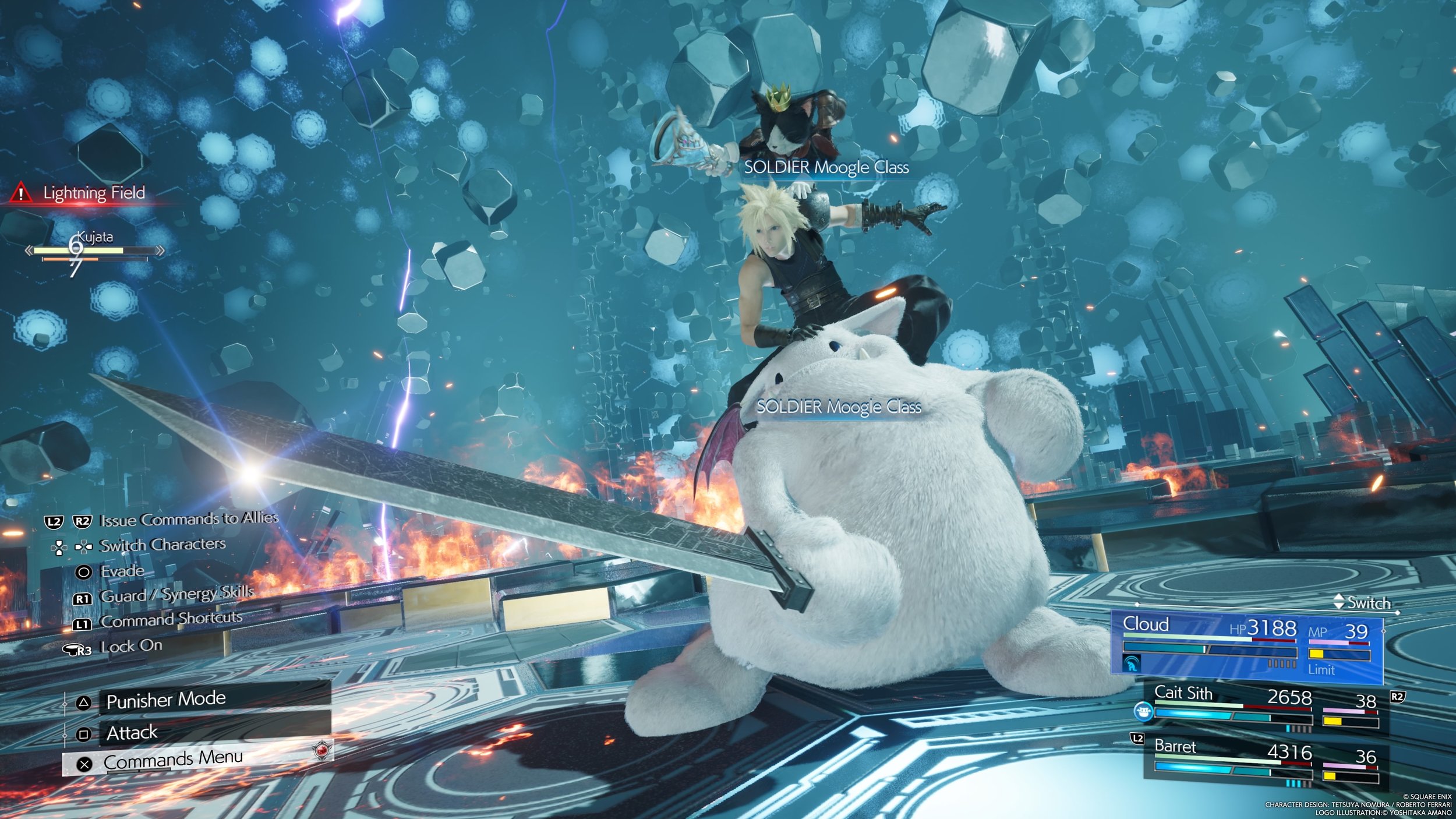
It is a fact generally known, that any videogame with an avatar that wields a sword as their primary weapon should inspire joy in the player by swinging it.
And there is no joy so great as swinging Cloud Strife’s buster sword.
Final Fantasy VII: Remake and Final Fantasy VII: Rebirth are videogames that have, since their release, opened to an incredible amount of controversy, acclaim, wonder, curiosity, speculation, and celebration. I cannot even consider a videogame released in the last decade with as much anticipation and/or concern as Final Fantasy VII: Remake had, nor can I adequately convey in words the energy that the first teaser trailers inspired in videogame players who had been, since they spent their summer days indoors summoning Ifrit instead of going outside and playing “the sports,” waiting for a remake or remaster of the original Final Fantasy VII. It is one of the greatest regrets of my life that I never played the original game when it was released (I never owned a Playstation 1 in my defense), and my shame only increases as I note that while I have started it in the last year, I have yet to play it to completion.
There’s just too many cigarette cards to collect in Red Dead Redemption 2.
And Koroks, there’s so many Koroks dude.
Despite this failure, I feel comfortable writing about both of these games having finished Remake twice and also, as of this writing, currently playing through Rebirth. My reasoning is since I’m focusing on the aesthetic of motion rather than the complete story, I don’t have to have completed Rebirth, plus the motion controls for the characters haven’t altered dramatically (or even all at) since Remake.
So as always I start with a question: why is it so fun to move and control Cloud Strife?
The answer is, because it’s incredibly fun.
Duh.
Management has just informed me that that is not a satisfactory explanation and that if I want to see my Steam account safely returned to me I will need to elaborate further.
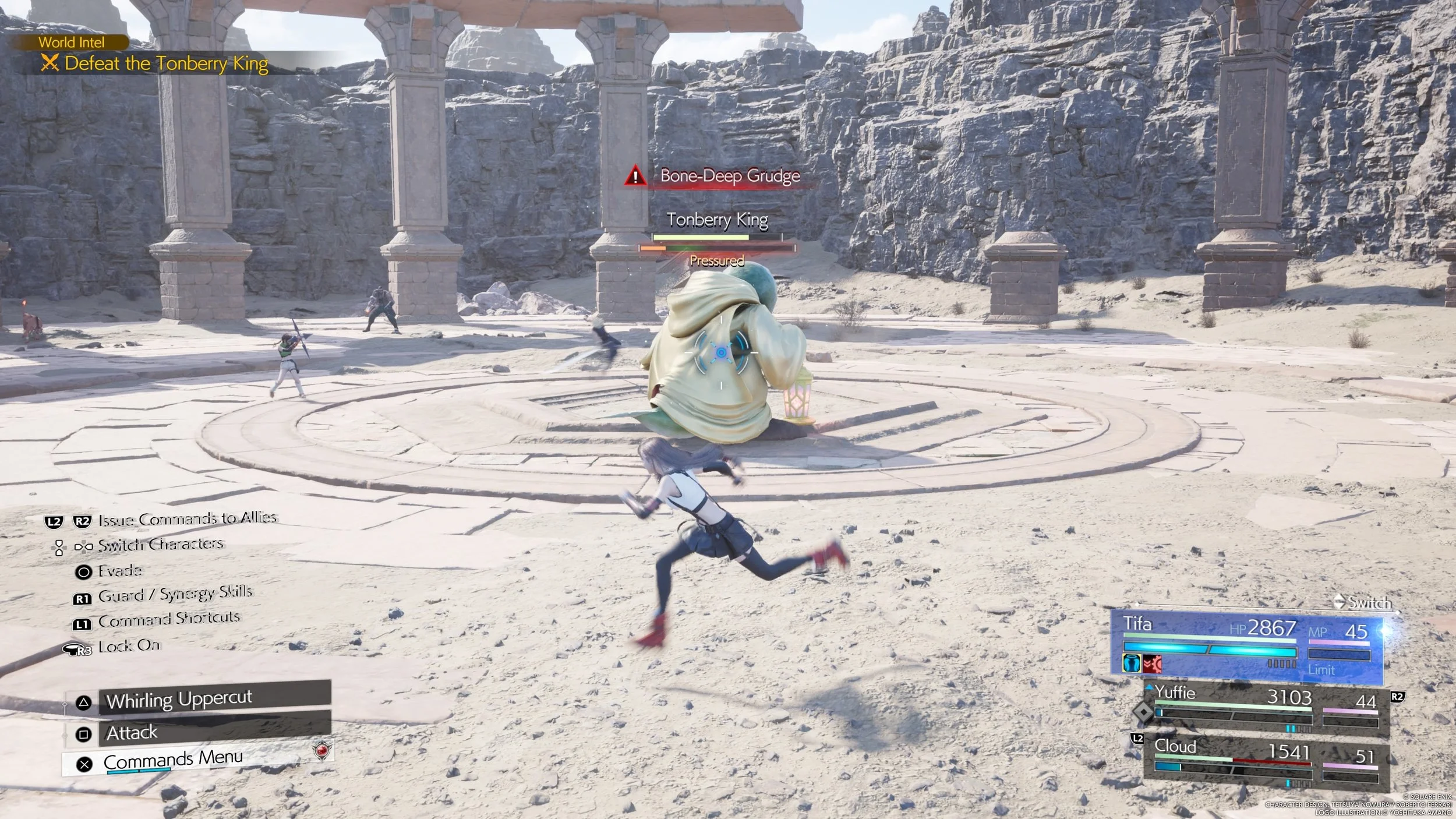
Cloud is a skinny dude wielding a sword as tall (and almost certainly) twice as heavy as he is, but darn it the dude works it. Cloud is able to run, jump, climb ladders, scale walls, rappel down ropes, drive a motorcycle, ride on the backs of chocobos, stop literal bullet fire, parachute through the sky, fight robots and fiends, make dramatic leaps, all while managing to keep his almost certainly manicured hair nice and pointy. Realistically speaking Cloud shouldn’t be able to wield this massive block of solid steel, but before I even finish that sentence I have to remember that this is a videogame, it’s a fantasy videogame, and one of the playable characters is a robot toy cat who wears boots and a crown, speaks with an Irish accent, and fights using a chonky moogle and a horn. Point is, realism is for fools, and Final Fantasy VII Remake and Rebirth are games that have shifted their interface away from turn-based-strategy menu combat to real-time action. The developers have created two amazing action-adventure videogames, and their desire to make that action enjoyable to control is present down to the most minute detail.
Let’s look at one example.
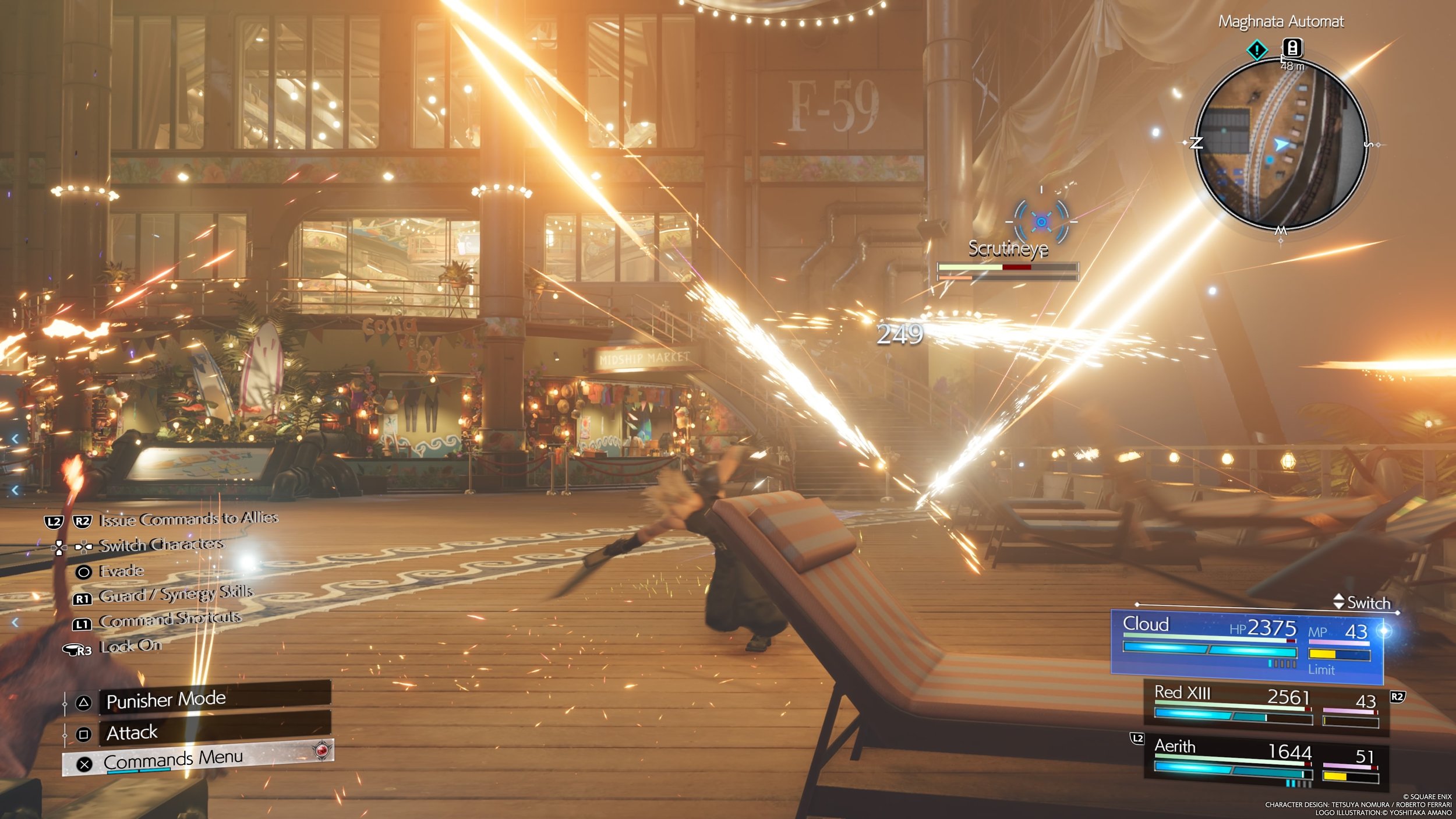
I am, as of this writing, working through Final Fantasy VII: Rebirth and taking my sweet time doing so because the game is simply spectacular. Seriously I could probably write a book about how beautiful this game is narratively, visually, rhetorically, etc. For brevity’s sake I’lll just note that the combat system is a particularly enjoyable aspect of the game, and I’ve purposefully just wandered the open world finding anything and everything I can to fight. And, naturally, between scanning crystals and activating towers, I've encountered fiends, a.k.a. Fantasy monsters that will trigger combat. Monsters will regularly appear in Final Fantasy VII Remake and Rebirth and when they do the combat begins and players are given control of one of the characters in the party. The game auto-assigns Cloud as the starting character, though players can change this if they want to lead with another party member. I typically just start with Cloud because his fighting style is familiar to me, plus, that Buster Sword swings like a beast. Pressing the action button triggers Cloud to make a short attack, but this action is a fast dramatic burst. Cloud doesn’t just swing the sword, his entire body follows the wave of gravity and the avatar fluidly shifts the weight so that the swing almost resembles a dance. Short attack actions can be made in quick succession too, so this dynamic energy doesn’t stop. Cloud will hop left, right, up, and down his body regularly leaving the ground as he follows the sheer, overwhelming kinetic energy of his Buster Sword.
Cloud swings and collides his blade into the bodies of dudes, monsters, more dudes, more monsters, even more dudes, and massive robots. Some of these robots…are also dudes. Cloud’s combat design makes it so that he is never a static image on the screen; his body is lost among the strikes.
And I ain’t even discussed Braver yet.
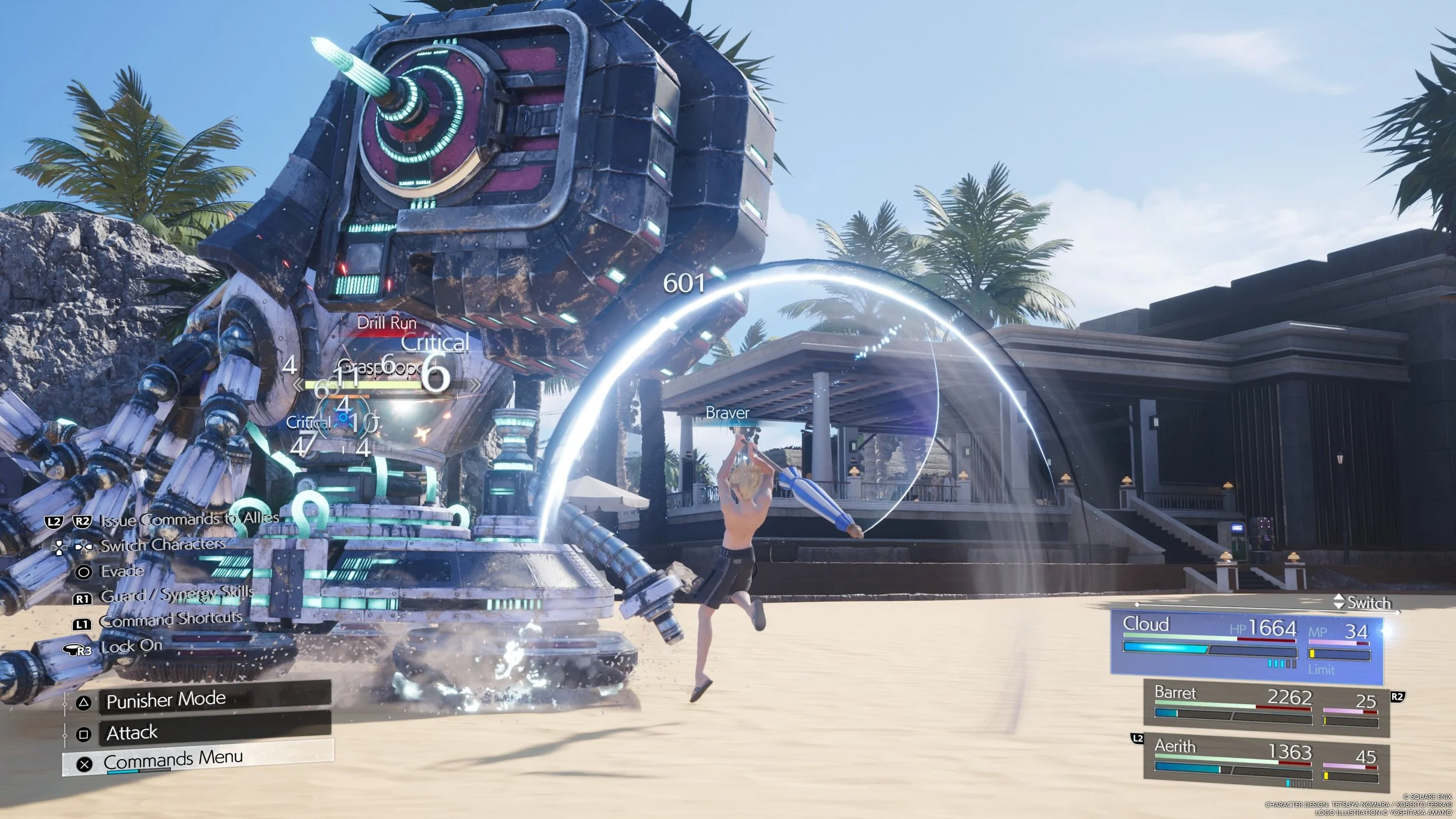
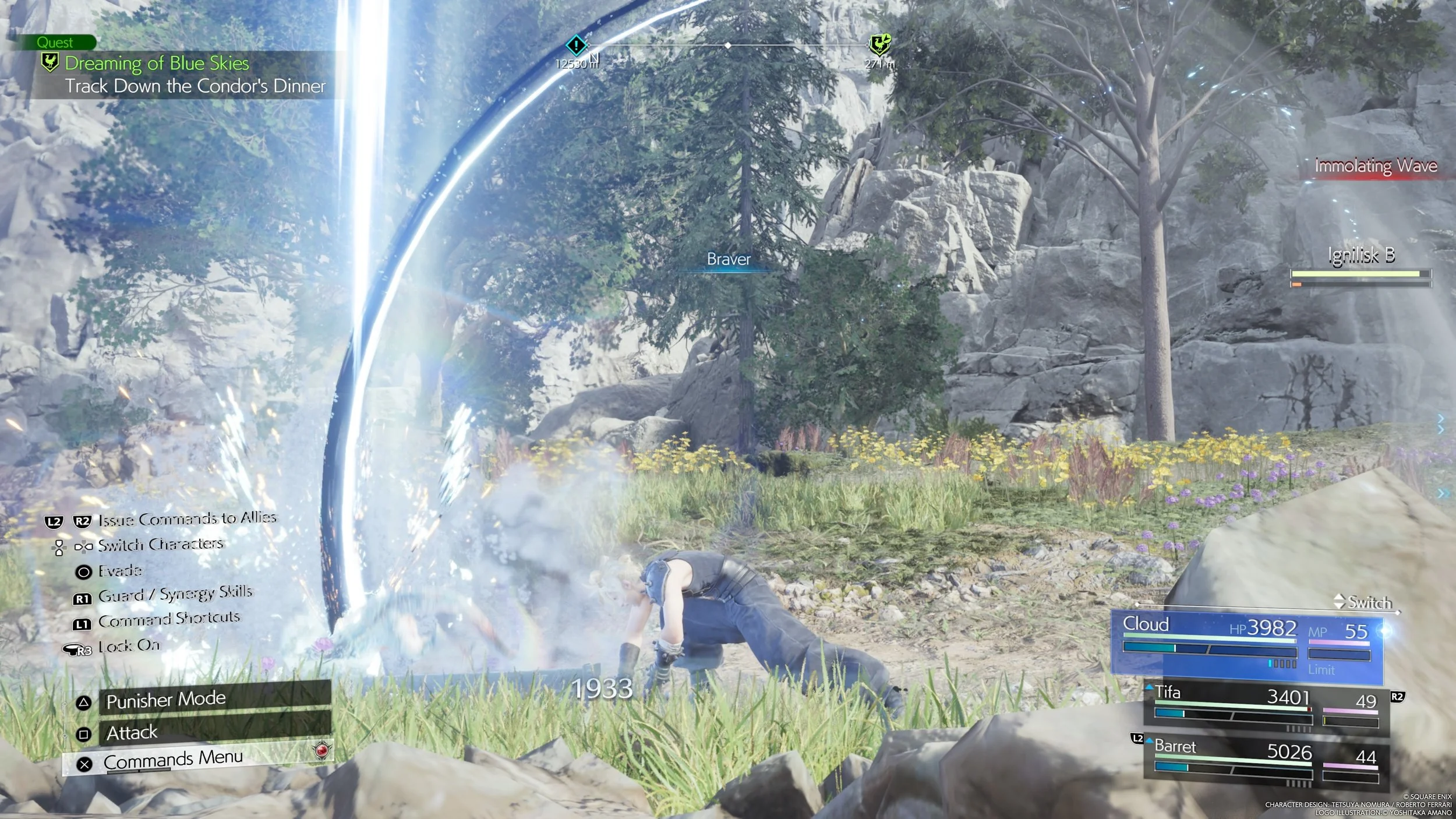
During combat there are several gauges that will steadily fill up as Cloud fights, and these will, once filled, allow him and other characters to perform certain actions. Sometimes this will allow players to “Summon” a spiritual entity to fight alongside them, other times it will trigger a “Limit Break” which is a special move unique to each character, and the ATB Gauge determines a players’ ability to perform a special action that is usually an extra strong basic move, cast a spell, or use an item. Cloud has several moves such as Focused Thrust, Triple Slash, Blade Burst, Disorder, and finally my personal favorite Braver. This last move involves Cloud literally swinging his blade in a wide circle, lifting himself up from the energy like Thor riding Mjolnir, and then slamming the Buster Blade down on his enemy in a devastating and borderline orgasmic cacophony of sound, light, and pure energy.
Braver is, and I cannot stress this enough, absolutely everything I’ve ever wanted from a videogame in a single motion. And, I can do it multiple times throughout a battle.
Joy is…too paltry a word for the sheer, overwhelming bliss that is watching Cloud perform Braver.
The joy of the combat in Final Fantasy VII Remake and Rebirth is not just the visual spectacle however because there have been plenty of action centered videogames that have provided visually spectacular fighting, but then failed the landing by not incorporating adequate sound design.
Speaking of games that did not fail, if I consider Punch Out for the Nintendo Entertainment System (NES) or Street Fighter 2 for the Super Nintendo Entertainment System(SNES) and SEGA Genesis I can clarify that last point. In the first game players control the protagonist Lil’ Mac, a boxer who clearly cheated the system to get into the upper weight classes. The goal of the game is to physically fight enemy npcs who each have their own unique call signs for revealing their weaknesses. I plan on writing more about Punch-Out in the future but for the time being what’s important is that the game is a perfect example of how sound in fighting videogames should work. Every punch Lil Mac makes is punctuated by distinct frequency. Granted this is the NES, which means every noise is a chirpy digital bleep, but…it works. Every punch that lands triggers the sound file and I begin to disappear into the flow state of the actual fight.
Likewise if I consider Street Fighter 2 it’s a cacophony of crunchy punches, grabs, and kicks. Street Fighter 2 is a standard fighting game about an international competition where players fight one-on-one with computer opponents or other players if they have friends (must be nice). Just like Punch Out players are constantly trying to land attacks against their opponents to work the health bar to zero and win the fight, and like Punch-Out every attack triggers a sound file that is aesthetically pleasing. The motion controls and combos necessary to land these attacks are worth exploring in and of themselves, but what’s important for this essay is how these sounds trigger an aesthetic response in the player. Every time San Gief slams his fist into Ryu the sound creates the impression that I am this unstoppable soviet behemoth, and that in turn only furthers my confidence to press the attack further.
This is all to say that sound generates further immersion into the experience, and leaves a player with the perception that they are this unstoppable fighting machine.
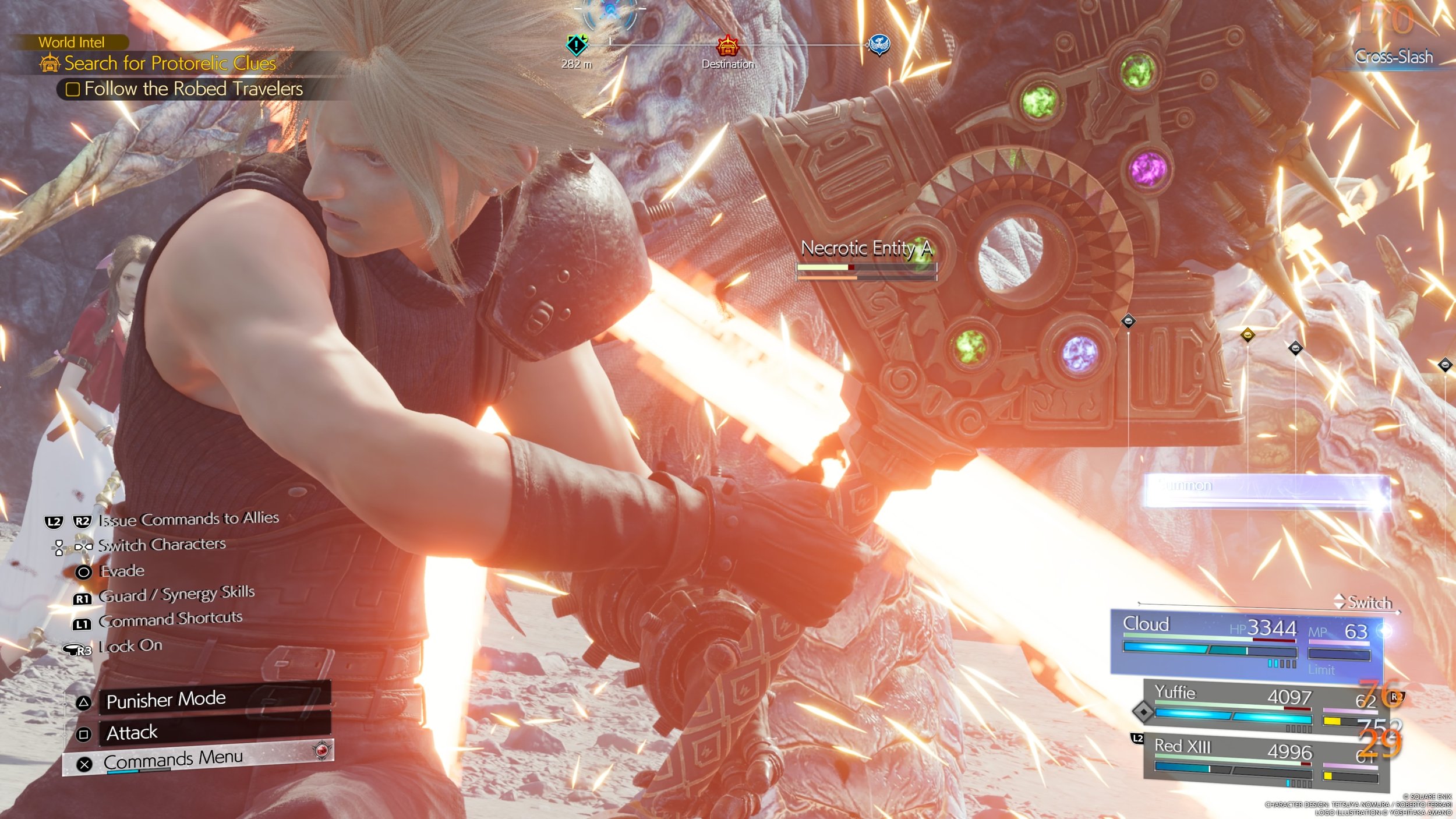
Final Fantasy VII: Remake and Rebirth are honestly some of the most well-designed videogames I’ve ever played, and sound is entirely at the core of the experience. When Cloud slices a fiend the audio-file makes the dramatic sound of the mammoth weight of the Buster sword propelling through space before impacting with the enemy and triggering the sound of flesh colliding with a brick of solid steel. Combat is fast with Cloud making slice after slice with the sword and even when his attacks are repelled there is a satisfying crunch of his blade reverberating back. The sound of Braver is particularly joyful because Cloud will often make a taunting remark before the sound of his blade triggers and he is lifted up into the air and then crashes into the earth like a colossal blast. It is, well, it’s flipping rad dude.
And I’m only writing about Cloud, I could spend paragraphs, pages, novels worth of digital ink explaining how sound is employed to make controlling Tifa, Barret, Yuffi, Aerith, Red XIII, and Cait Sith an endless font of joy.
Action-based videogames, when they’re designed well, instill an overwhelming sense of confidence in players through interactions. Every command I send through my gamepad or keyboard has an immediate effect, and the execution of strong visuals and well executed sound design all coalesce to make me disappear into the sheer joy of moving Cloud around this world fighting anything in my way. Even in fights where I lost what I couldn’t take away from either Remake or Rebirth is that controlling these avatars was overwhelmingly fun.
At this point though it’s important to consider the narrative depth of Final Fantasy VII: Remake and Rebirth because it’s tremendously relevant for all of these motion controls.
Final Fantasy VII: Remake and Rebirth follow Cloud as he meets Avalanche, assists the attacks on the Mako Reactors, fights Shinra to stop them from collapsing the Sector 7 Plate, rescues Aerith from Shinra’s lab, fights Sephiroth and an army of whispers (shadow creatures that control fate and destiny) and then leave Midgaur to begin searching for Sephiroth who is scheming destroy the planet for human life in order to remake the world for an ancient race of beings.
Also there’s dancing mini-games and a scene where Cloud rides a dolphin, but I’ll write about those at a later date.
The narrative is complex with subplots, side-quests, role-playing opportunities, and even a dating/romance simulator embedded into Rebirth’s storyline. All of these story-elements revolve around Cloud Strife as he is steadily moving forward to face up against Sephiroth, his childhood hero who has completely lost his mind, as well as reconciling his past which seems to be a source of constant frustration and mystery. Everytime Cloud encounters some reference to his childhood, or even the last five years he experiences an immediate headache, with reality crackling and overwhelming his ability to perceive the world.
Through these story-beats what never changes is the perception that Cloud is constantly presenting and manufacturing a persona of assurance while in reality the ground of his psychological being is constantly in flux.
Putting it simply, Cloud is a man lacking confidence, but projecting a superficial veneer of it. And that’s become significantly relevant as I consider controlling his avatar.
I’m not a terribly confident person. In fact I have criminally low self-esteem to the point it’s a source of frustration for friends, family, and that dude at KFC who just wanted to know if I wanted mashed potatoes with my 12 piece bucket of original recipe. I did by the way, but only because my girlfriend is a vegetarian and loves mashed potatoes. It’s not too much to say that one of the reasons so many of the videogames I play are action-adventure, or have some action elements, or, at the bare minimum involve direct-control mechanics is because these games allow me to inhabit a body, or at least mindset, that possesses a confidence that I do not have in real life. Cloud Strife is a perfect embodiment of that desire.
Like me Cloud is riddled with insecurities, but unlike me he’s athletic, incredibly strong, pumped full of performance enhancing magic/science, and is able to perform feats of strength and athletics that my (over the age of 30) body can never and will never perform. There’s a joy in controlling an avatar which is able to demonstrate such incredible feats, but beyond the superficial aspects of the software itself there is a human being whom I recognise. I’ll be honest I don’t completely identify with Cloud, mostly because the dude isn’t gay enough, and I can’t vibe personally with the whole brooding, apathetic-to-everything masculine type (I did enough of that as a teenager). But I do identify and love controlling Cloud because his story is emotionally engaging, and the physicality that he’s constantly demonstrating, whether it be fighting dudes while riding a motorcycle, battling titanic monsters, making gargantuan leaps from one stack of rubble to the next, everything about the character and his motion only engages me and makes me want to continue playing.
Narrative is not the easiest argument to make when exploring motion control mechanics in a videogame, but in the case of Cloud Strife I think narrative is just as important to understanding why it’s so fun to control him. I learn through the story that Cloud is an Ex-Soldier, part of an experimental Super-Soldier program operated by the Shinra corporation. While in Final Fantasy VII: Remake we’re given some understanding of how this impacts people like Cloud, it isn’t until Rebirth when I regularly encounter former soldiers who are now mindless souls wandering the continent towards some mysterious goal that the motion mechanics take on a new dimension. Whereas in Remake I enjoyed controlling Cloud because he was just an awesome fighter, in Rebirth there’s a new realization that all this energy and strength is finite.
Sooner or later Cloud will become one of these mindless souls, drifting through the world.
This body that I control will eventually break down.
And most importantly, at some point I won’t be able to control it any more.
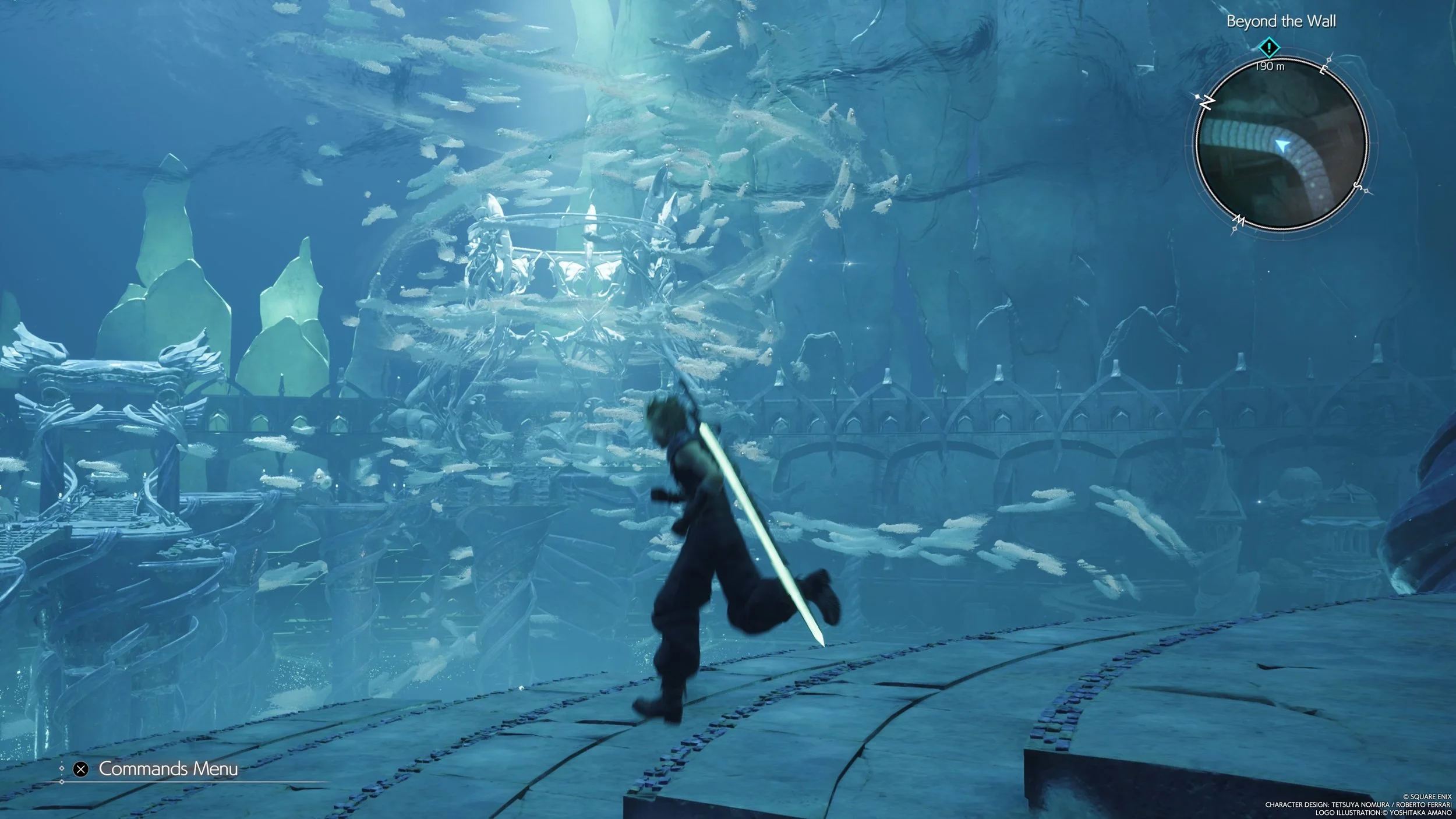
This realization is something of a Mimento Mori (Latin phrase that roughly translates to “Remember you are going to die”); but it’s also being employed to mirror the larger meta conflict that’s transpiring within Final Fantasy VII. The central conflict that Cloud faces is one that all of the characters in the game struggle with, namely that there are forces that are impacting the control over their own lives. Nearly every effort of Avalanche to disrupt Shinra operations is foiled or turned against them. The Shrina corporation is destroying the planet with its unrelenting industry and disregard for the cost of human life. Sephiroth is using his powers (and insanity) to summon a meteor that will destroy all life on the planet. And finally Cloud himself is constantly beset by the perception that his memory is being tampered with and that his choices are being made for him by an outside power. All of these recurring narrative elements develop the player’s perception that they are in a constant struggle, and that the only way to overcome these obstacles is to fight and just keep moving.
Or perform in an elaborate dance sequence that ends in drag.
But that’s an essay for another time.
A narrative is not necessary for motion controls to resonate satisfaction within a player’s mind, after all as I argued in the first Joy of Movement essay, a game like Pac-Man has no real narrative but it’s a master-class on how motion controls can be used to generate joy in a player. What makes Final Fantasy VII: Remake and Rebirth different is how narrative is just as much a detail of design. Cloud’s conflict informs so much of the motion a player is able to control. Whether it’s the massive swings of the buster sword, the flips and jumps taking place during battle, the unrelenting might and power of a Limit break, or even just riding a Chocobo across a field to reach one more bloody tower, every moment of controlling Cloud inspires joy in me.
Just like Link, Ristar, Wario, The Spartan, and Pac-Man, Cloud is fun to control because of the excellence of the design choices that went into making him.
So once again I end with the question I started with: why is it fun to control Cloud Strife?
The answer is…because he has a totally sick fantasy blade.
Once I make my first strike, and the tempo of the battle begins, and Cloud’s arms and feet begin to move I simply don’t want to stop.
Joshua “Jammer” Smith
3.2.2026
Like what you’re reading? Buy me a coffee & support my Patreon. Please and thank you.