Hello Kitty and Friends-Happiness Parade: Joy of Movement
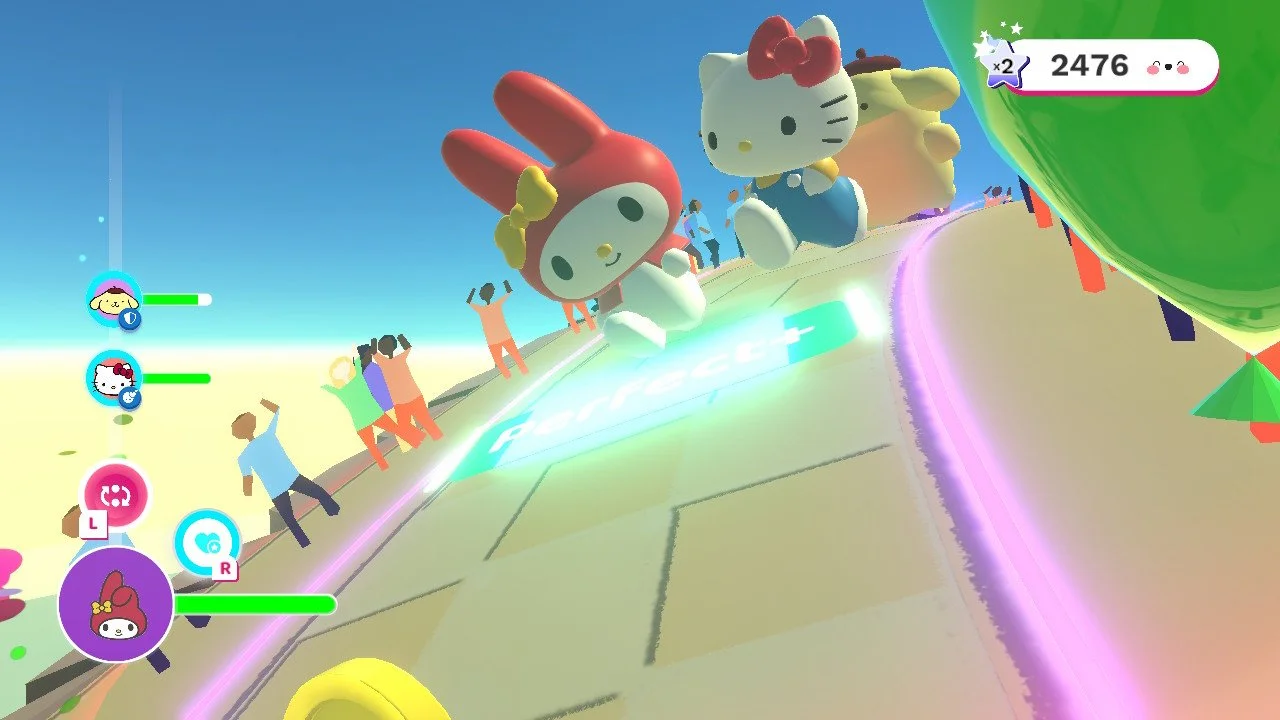
The question I ask in every Joy of Movement essay is, in this particular instance, answered before I even begin writing.
Why is it so fun to move Hello Kitty?
Because she looks so damn sweet and precious as she’s dancing along to the beat.
After playing Hello Kitty’s Flower Garden and writing an essay about it, and then actually buying Hello Kitty Party for Nintendo DS, playing it, and writing another short essay about it I realized that I wanted to play more of them. I will admit honestly that part of this is a personal joke at my own expense. A 36 year old white, cisgender dude on the internet playing and writing about Hello Kitty videogames is, to quote the Austrian-German Philosopher Ludwig Wittgenstein “Cringey as balls…yo.”
But as I noted in my previous two essays, unlike a multitudinous number of licensed videogames that have been hastily churned out for the purpose of maximizing profits off of an intellectual property, I’ve found that Hello Kitty videogames have a concern for design that reveals efforts to make actually enjoyable games.
And given the context of the history of the Sanrio Corporation this makes absolute sense.
Sanrio Company, Ltd. began in the 1960s as a general manufacturer of clothing goods and then shifted production to merchandising. Sometime in 1973 Shintaro Tsuji (the founder of the company) ordered his designers to create original characters so that they would no longer have to pay licensing fees. Hello Kitty was one of these early designs and quickly acquired popularity among customers establishing her as the unofficial mascot of the corporation. Sanrio began producing varieties of merchandise, but often would focus on professional office supplies such as notebooks, envelopes, pens, etc. due to the ever rising mental health crisis that faced professional employees in Japan; today this crisis even has its own name: karoshi.
The ethos of the Sanrio is trying to create happiness, and inspire joy.
If it ain’t obvious already, that ethos is important to this essay.
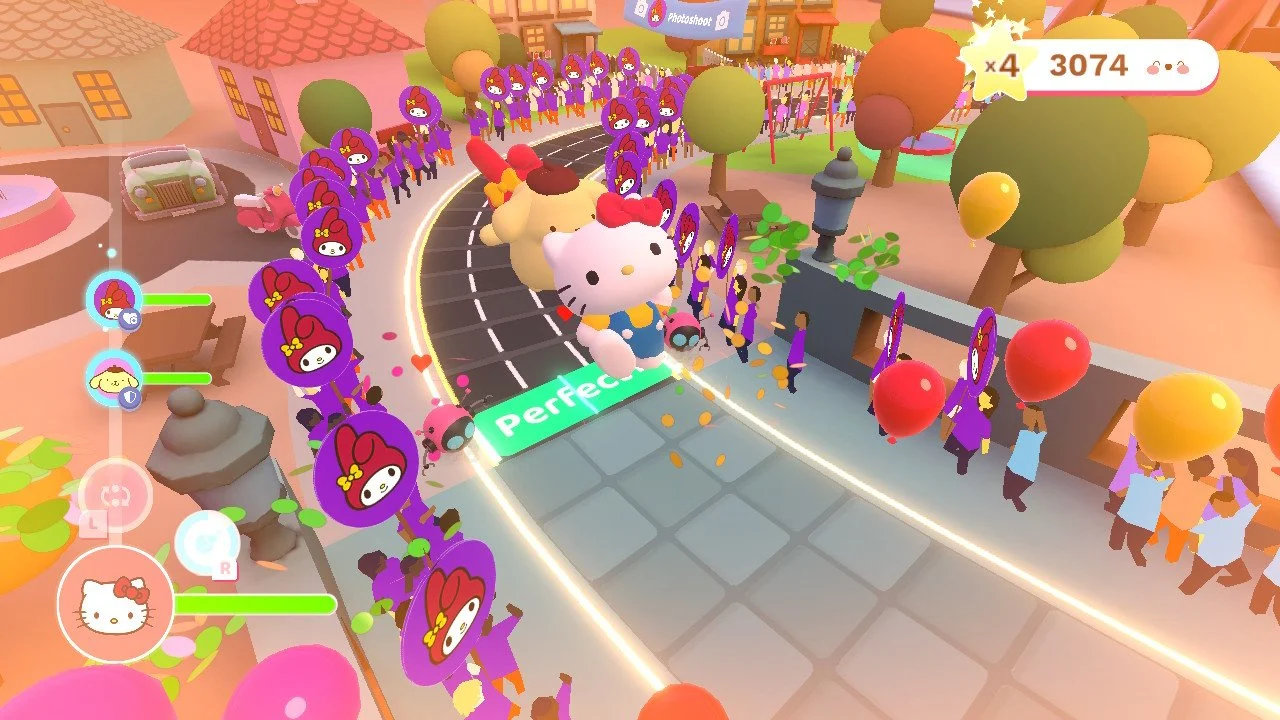
I’ve started looking for any and every Hello Kitty videogame I can get my hands on, which is honestly a struggle because most of the games at my local Game Xchange are Madden Football or Fallout 76. Fortunately emulators exist, and there are still some games I can find on the Nintendo Switch, which is how I discovered Hello Kitty and Friends: Happiness Parade.
Having played more than a few Hello Kitty videogames, I can say that Happiness Parade is my favorite. I love the game because it inspires joy without pandering to me. It provides me with avatars that are visually charming, while also making them fun to control. It creates a positive atmosphere that, while it can be abstract and surreal at times, has been designed with a concern for detail so that I never perceive that my characters are simply floating about in a void.
Apart from having too long a name (and originally being a mobile game for iphones and Android(and being published by Netflix for pete’s sake)) Hello Kitty and Friends: Happiness Parade is a game that I did not anticipate enjoying as much as I did. I’ll admit just looking at the description of the “narrative” I anticipated being able to compose one of my Under 500 Words essays about this game and then move on to writing yet another essay about Super Mario Bros. 3. I mean, it’s a game about walking and dancing, how much joy could that inspire?
As it turns out, a tremendous amount of joy.
There isn’t a true narrative to Happiness Parade; players control Hello Kitty (and two of her friends) through the courses of several parades which are set to popular music. Though I immediately note that I recognised none of the songs before playing the game so how popular could they really be? The story, such as it is, is that Hello Kitty and her friends are marching in parades and trying to inspire joy to the human characters that stand and dance along the edges of the parade. Depending on how well players navigate the parade route, I can either expect to receive rewards at the end in the form of points and collectibles, or they lose and have to start over from the beginning.
Happiness Parade is a Music/rhythm videogame where parades are, in effect, obstacle courses that vary in difficulty. Players are supposed to press buttons to match the rhythm of the song that is playing and this in turn synchronizes Hello Kitty, PomPomPurin, Kuromi, Penguin Sam, My Melody, Cinnamon Roll, etc. to the beat. Depending on how well timed the player matches the beat will determine how much happiness is created with each button press. How well the time is kept is only part of the challenge though because these parades also include enemy non-playable characters(npcs) in the forms of bugs that will drop purple paint or dig holes in the ground to trip the characters up. There are also fences, massive pendulum-swinging-hammers, and rotating spiked boxes which can collide into Hello Kitty, disrupting the flow of the melody and breaking up the happiness-energy that was being generated. With every successful beat the happiness of the parade is steadily increasing and so anything that interrupts the player’s dance moves disrupts the volume of the music playing. The challenge, and thus the joy, comes from maintaining a consistent and uninterrupted groove.
But wait, it gets even better.
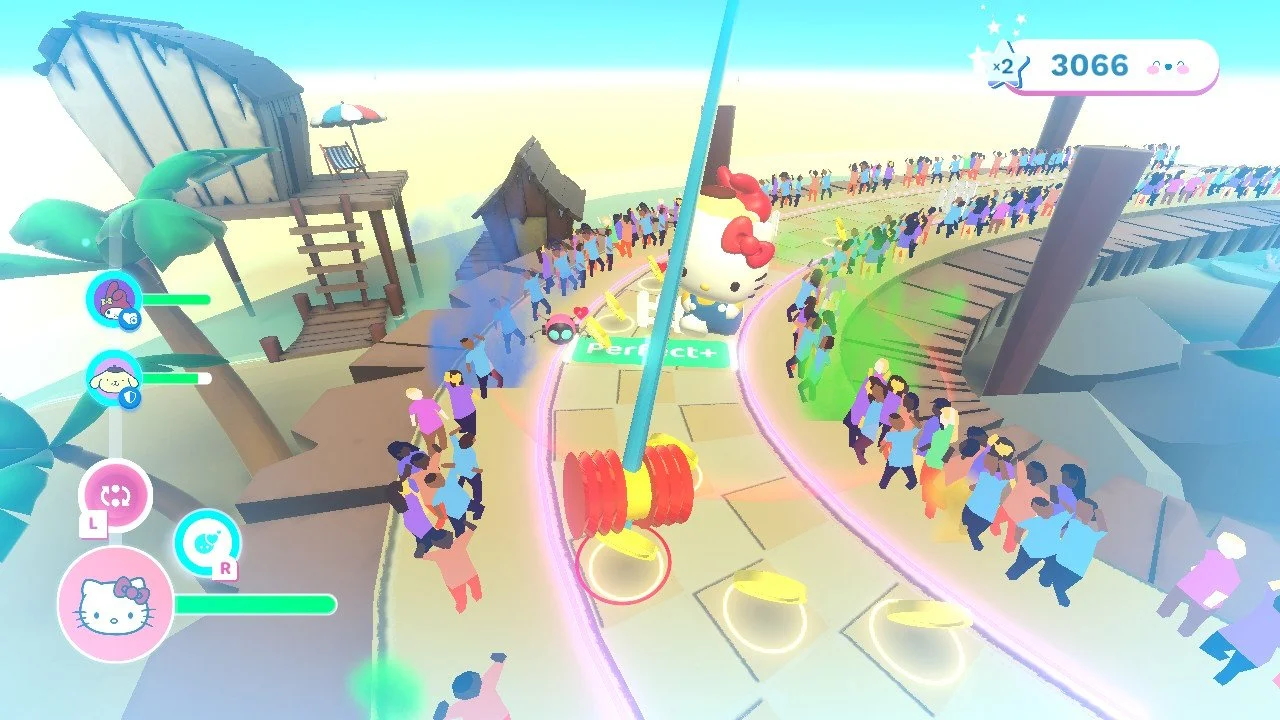
Each member of the three-person parade has an HP(Hit Points) meter and if they stumble into enough obstacles their character will disappear, reducing the party down to two members. Dancing becomes not just about timing the right button-press it also becomes about making sure to not get hit and kill the vibes.
And as Wittgenstein noted in his original manuscript to Philosophical Investigations, “Vibes…are everything…yo.”
The challenge of writing something meaningful about a videogame about corporate mascots dancing ecstatically to popular music is difficult because there is no way (at least in my native english language (or possibly any language spoken by human beings (or possibly even machines))) to properly communicate the energy of playing a round (or rounds) of Happiness Parade. I recognise that it’s already a hard sell because, again, from afar there’s so much commercial product in the aesthetic and even playing the game is perpetuating knowledge of the product. Videogames as a medium are, and have been, plagued by the bias that they exist simply as commodities and assets of capitalism rather than art objects, or work that warrants serious media analysis. And, it doesn’t help that Happiness Parade is a fun pinball-slot machine of a videogame complete with bright flashing lights, vibrant colors, exuberant sound files, and popular music from real musicians, all compiled together with rhythm mechanics that’s just sheer bliss to consume.
It all seems superficial, like a digital Snickers bar. Maybe it is. But there is a rhetorical design to it.
Again, hear me out.
Joy is happiness and happiness is an emotion. Any work of art can, and should, inspire the reader, viewer, and this case player by engaging them intellectually and emotionally. When I consider the media that I tend to consume I recognise that Joy is not always the immediate goal of the work, or, at least not familiar and visible Joy. For example when I play PowerSlave Exhumed, Resident Evil 2: Remake, or Ghostwire Tokyo the impression I’m left with in those games is not obvious Joy because all of these games involve using some manner of weaponry to destroy monsters, demons, ghosts etc. From an outside perspective such actions shouldn’t bring me joy…but they do. The aesthetic goal of each of these games is to entertain me by providing me fun challenges whether it be controlling my avatar to move through a simulated space, figure solutions to puzzles within the game, and, again, using weapons to shoot monsters like zombies or demons. The motion controls, sound bytes, musical scores, visual atmosphere, and interactive controls all generate this wonderful perception that I am powerful. And even in instances of survival horror games like Silent Hill, Dark Wood, Resident Evil, Pathologic, or Little Nightmares where agency is regularly reduced, all of the elements previously listed leave me happy because they work together to create a beautiful work of art that makes me happy to observe and interact with it.
The joy, the happiness, is the end goal.
With Hello Kitty Happiness Parade the goal is right there in the gosh-darn title.
Works of art that are created with the goal of inspiring happiness are easy to ignore and dismiss just as quickly as they arrive, and I’m not immune to this impulse myself. Working at a public library I regularly help patrons find books and films that, generally speaking, were made to be entertaining and/or reaffirming people’s comfort. I’m confident that I’m not the first person to look at a DVD of a Hallmark movie about some woman inheriting a miniature horse farm and then falling in love with the hunky ranch-hand who ran the place with her great-uncle before he died and think, “Hmmm, no thanks.”
It’s shmaltzy.
It’s sacchrine.
It’s cliche.
It’s goofy.
It’s trying to make the viewer happy.
But why is that a bad aesthetic goal?
The answer is…it isn’t.
As Witgenstein pointed out in his book Culture and Value, “Happiness ain’t the problem, it’s how you’re making the happiness happen…yo.”
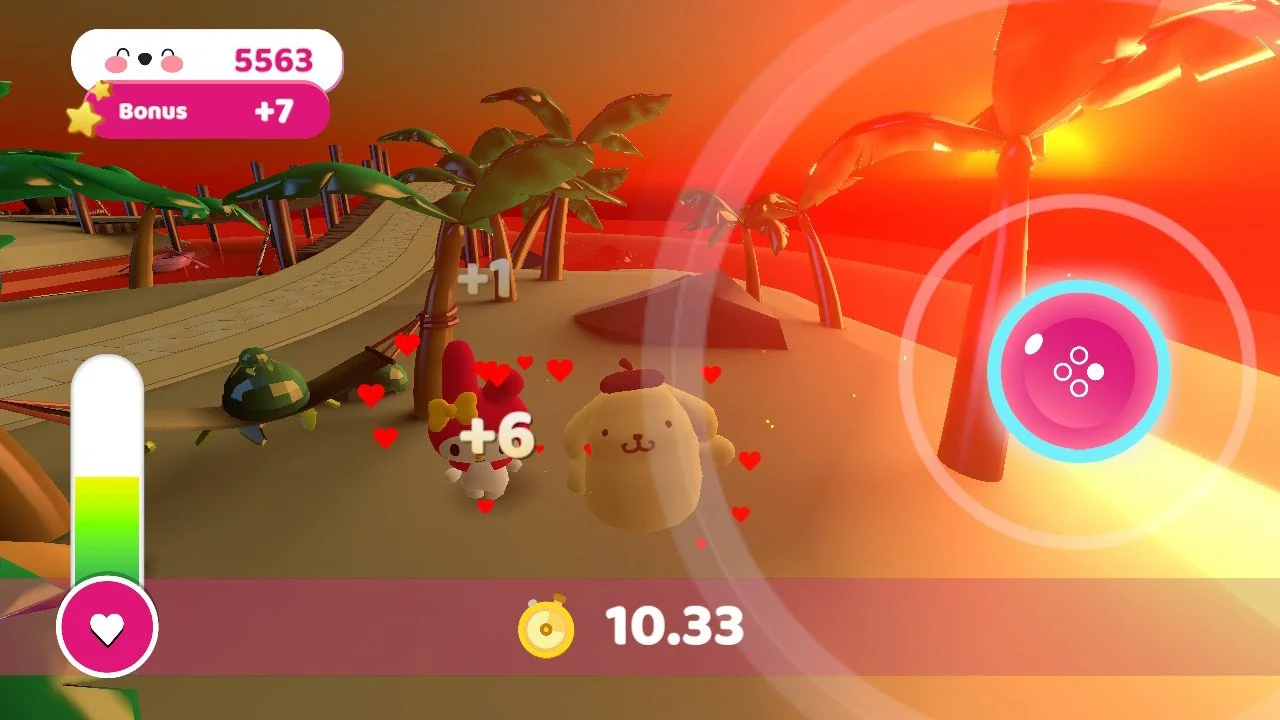
Happiness Parade is not trying to address a complex intellectual conundrum, but the game is also not an empty experience. It’s using motion controls to generate puzzles that are engaging and require quick reflexes. It’s using popular music, but it’s also using music that is trying to generate movement and happiness thus creating a flow state that a player can quickly engage with. It’s using corporate icons that were literally generated to comfort exhausted professionals, but those icons are visually distinct and give the game a dimensional quality that wouldn’t be achieved if it used a general humanoid sprite. The visual aesthetic is simple and iconic in the sense that it’s using cartoon icons rather than three-dimensional photo-realistic characters, but that iconography allow’s the player’s mind to imprint upon these figures and thus perceive themselves closer to Hello Kitty and her friends.
All of this is designed to make the player smile, laugh, and just play.
As a rhetorical design it’s a success, and the movement is at the center of this success.
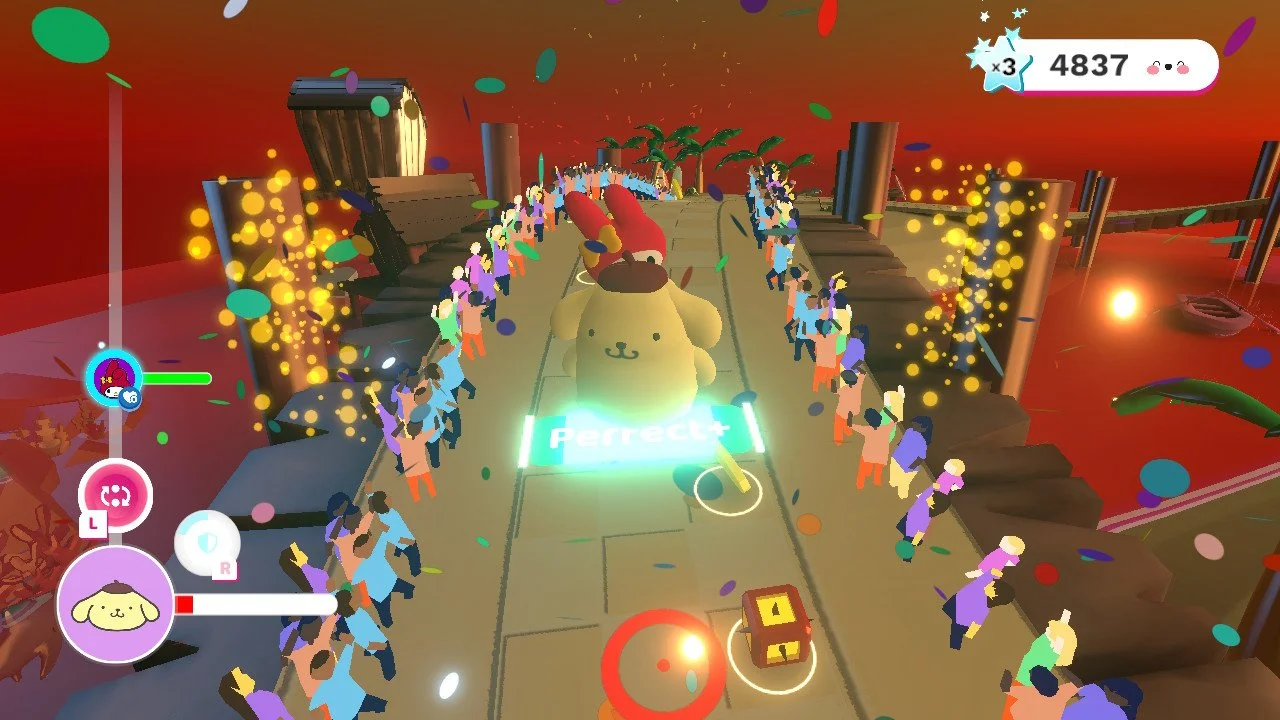
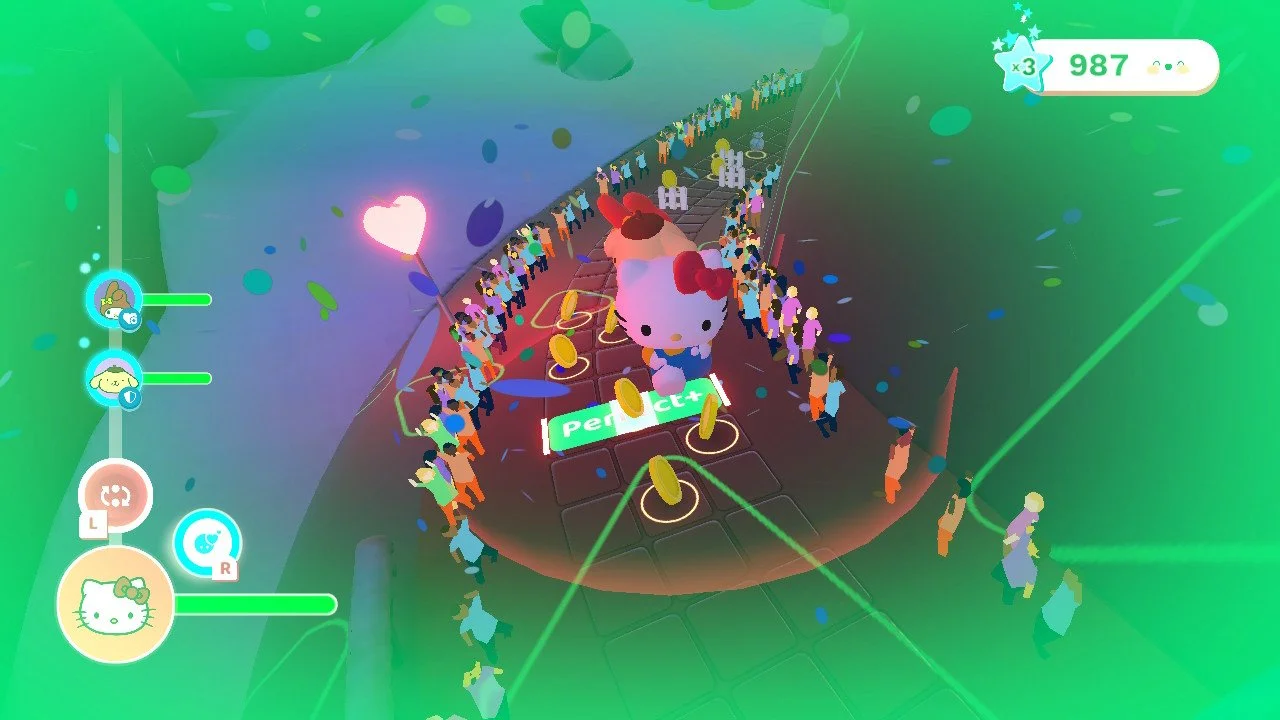
One design that really reinforces the joy of movement in the game is how the characters dance. At the start of a level Hello Kitty, Pom-Pom Purrin and My Melody (the opening available characters) step to the beat, their floofy bodies gently swaying with each step. For every well-timed step a meter in the upper right hand corner begins to fill. If a player is able to maintain their step and avoid obstacles the star meter will fill completely at which point Hello Kitty will begin to dance with more zest. Where before her head would simply bob, now her arms and legs will begin to move. If the player continues to successfully loop around the track eventually Hello Kitty will not just bob her head, she will literally hop and kick her legs out, wobble her head back, and seem to clap in the air with every step. Meanwhile behind her Pom-Pom Purrin who simply wobbled left and right will begin to pump his arms forward and twist his chonky body around while his ears bob. This success also comes with visual and audio clues such as more music, more enthusiasm from the crowd, and sometimes a quasi-lazer light show.
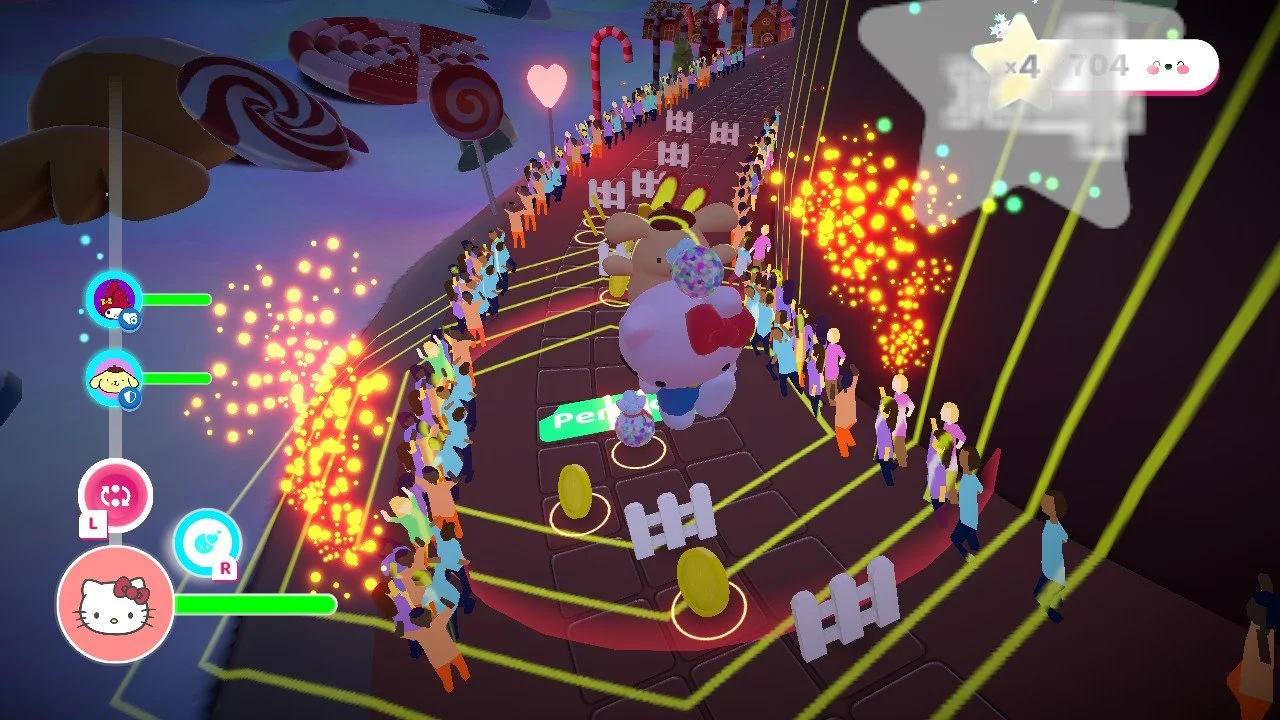
All of these details coalesce around the motion controls. Like Dance-Dance Revolution, the goal of the game is to encourage players to match the flow state of the music while Hello Kitty and her friends work their way along the set path. Which, on that note, I admit that when I saw the general structure of this game that I assumed the limited space to move would take me out of the game, when in fact this limited space to work instead created this magnificent tension, especially in the later levels when bugs, barriers, and traps began to occur more frequently. I found myself actively working and testing my controls to determine new strategies to make sure nothing killed the energy of the parade.
I have to admit here that watching Hello Kitty dance was so cute it was downright painful, but even more painful were the moments when I stumbled into a fence, fell into a hole, or crashed right into the path of a bug. The music lowered distinctly enough that I watched my flow-state practically vanish and Hello Kitty’s ecstatic energy fizzled out.
It was here that this essay came to existence because the question I always ask is answered: why is it so fun to control and move Hello Kitty?
Because controlling Hello Kitty is fun.
Duh.
It’s entirely because of the movement, and when the movement stops or slows the joy begins to recede.
Any and all motion/rhythm video games are about maintaining the beat and flow state of whatever music or energy is being provided. Hello Kitty Happiness Parade understands how important that flow state is and builds its visual, auditory, and ludic energy around that principle. Even players who would never in their lives imagine themselves playing a Hello Kitty videogame (which would have been me four years ago) will be transfixed by the energy of this game because every detail is generating and perpetuating motion.
Hello Kitty is not Ristar, she’s not Wario, she’s not The Spartan, and she’s definitely not Pac-Man. But like each of these characters she’s the focus point of a motion simulator that succeeds beautifully in inspiring joy.
And, as Wittgenstein said in his closing passages of his book On Certainty, “Joy’s what’s it all about in the end…yo.”
Joshua “Jammer” Smith
2.9.2026
Like what you’re reading? Buy me a coffee & support my Patreon. Please and thank you.