492 Words About: Donkey Kong 64 Character Barrell
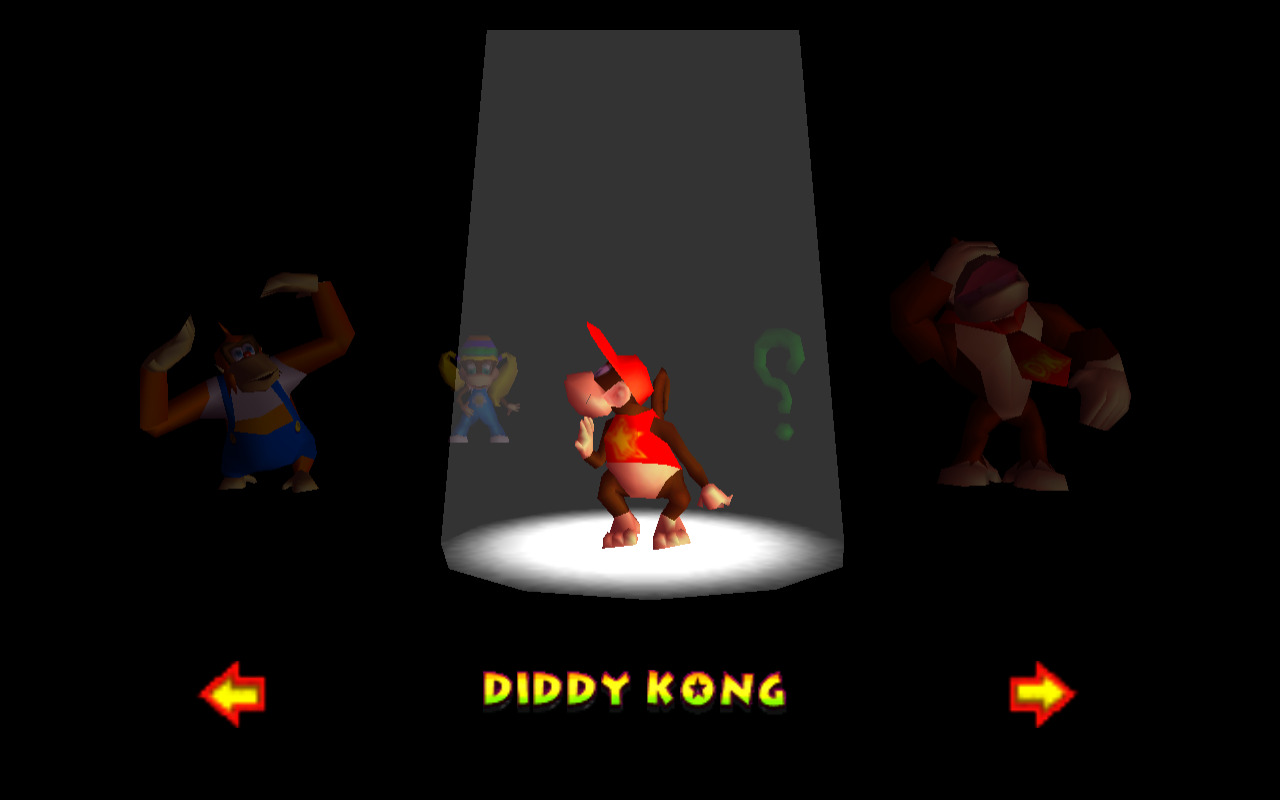
Menu options and aesthetics matter in videogames.
Here’s an example.
As of this writing I’ve started replaying Donkey Kong 64 on my PC. I played it originally on Nintendo 64 but my little sister enjoyed it far more than I did, and, this is important, she was actually good at it. I enjoyed controlling Donkey Kong but my favorite character was always Chunky Kong (he had a pineapple bazooka (nuff said)). Whenever the game begins the player will always start with Donkey Kong, however the game is designed with literally hundreds of collectible items, several which can only be acquired by playing as a different kong. As such the player will regularly have to change playable characters.
Scattered across Kongo Bongo Island are floating barrels. This is common for any Donkey Kong videogame, but these barrels have faces on them. When Donkey hops into one the setting immediately shifts to a dark black room illuminated partially by an unseen light that frames Donkey Kong, while behind him are the other four playable kongs (Diddy, Lanky, Tiny, and Chunky).
In most of the videogames I’ve played, character selection is static. Players are given images of a character, and when they select the character their sprite might move an arm or hover in place, but that is the extent of the selection process.
Moving the joystick away from Donkey Kong I watched the red-tie clad gorilla visibly and audibly groan before slapping his forehead. When I selected Tiny Kong I watched her dip her head down and playfully kick her foot. When I moved the light away she made a loud “hmpf” and stomped her feet visibly angry. As for Chunky (my main dude) he would gasp, ask if I was making the right choice, and then wave for me to select a different kong. When I moved the light away from him he let out a loud “whew” before waving his hands at me to select him again.
This selection process was fun. In fact it was a solid jam.
I wound up playing with the character select barrel more than the actual game.
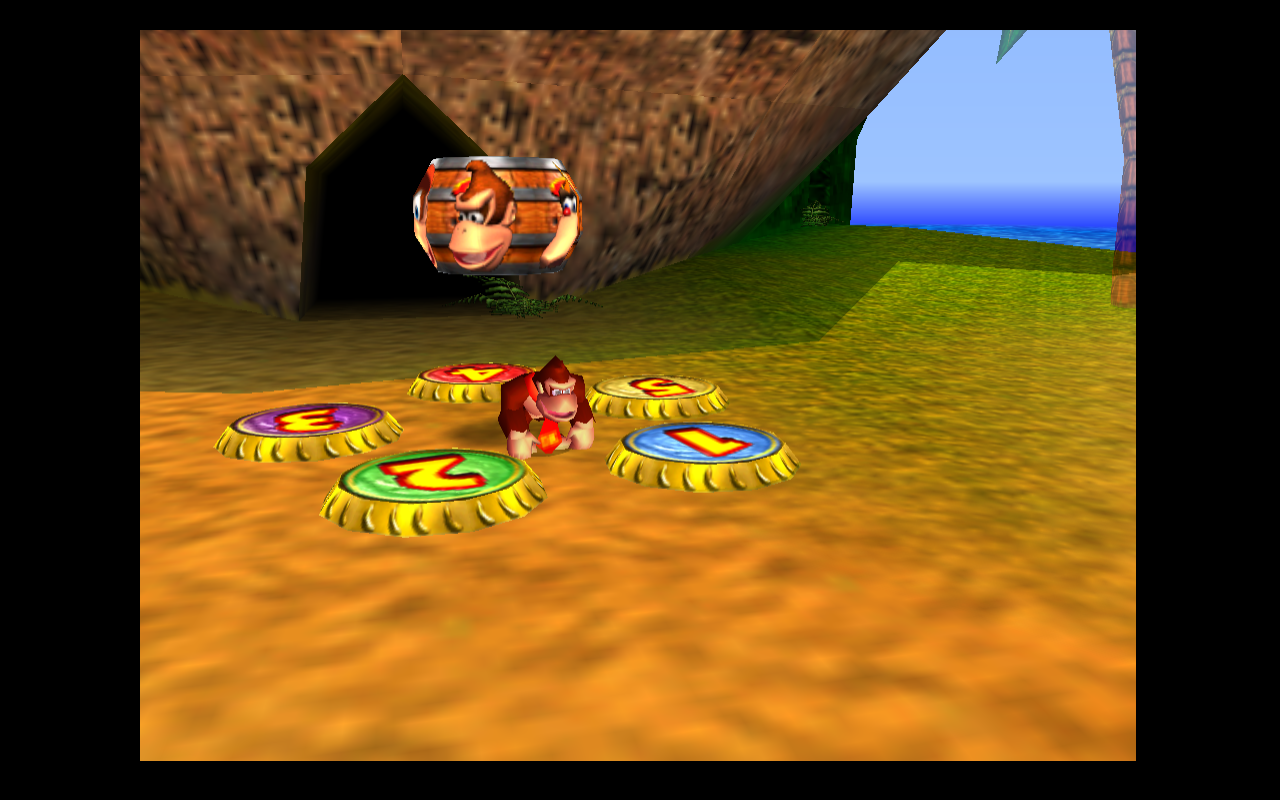
The novelty of this system was charming, but the character building was far more interesting to me. Donkey Kong was cool and ready to rock, while Chunky was a scaredy cat who only wanted to look tough. The lazy-susan effect of selecting these characters, and their immediate response to the discovery that it was their turn to explore was unlike any menu selection I’d ever, and honestly have ever experienced.
Software design in videogames menus can be coldly utilitarian since it’s typically made to be a precursor to the actual fun. But this betrays a boring, capitalistic mentality that stands opposed to the entire concept of a game. Donkey Kong 64 was full of details, and while most of those details were bananas, blueprints, and crystals there was concern for user interface even down to in the goofy menus.
Joshua “Jammer” Smith
2.16.2026
Like what you’re reading? Buy me a coffee & support my Patreon. Please and thank you.