493 Words About: DK Junior Math
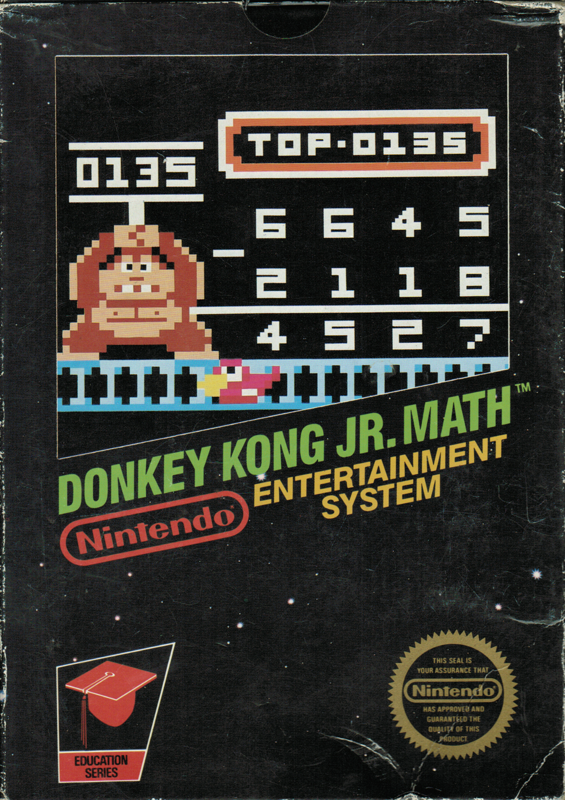
Cover image provided by Moby Games.
Here’s a fun fact, Math rocks.
I would have spat in your food if you told me that 25 years ago, because 25 years ago I hated Math. I loved videogames (still do(obviously)) and it’s a shame I didn’t find more math-centric videogames when I was a kid because it would have certainly helped me establish a better intellectual foundation for appreciating the subject.
On that note, I’m pretty sure that I still would have enjoyed DK Junior Math.
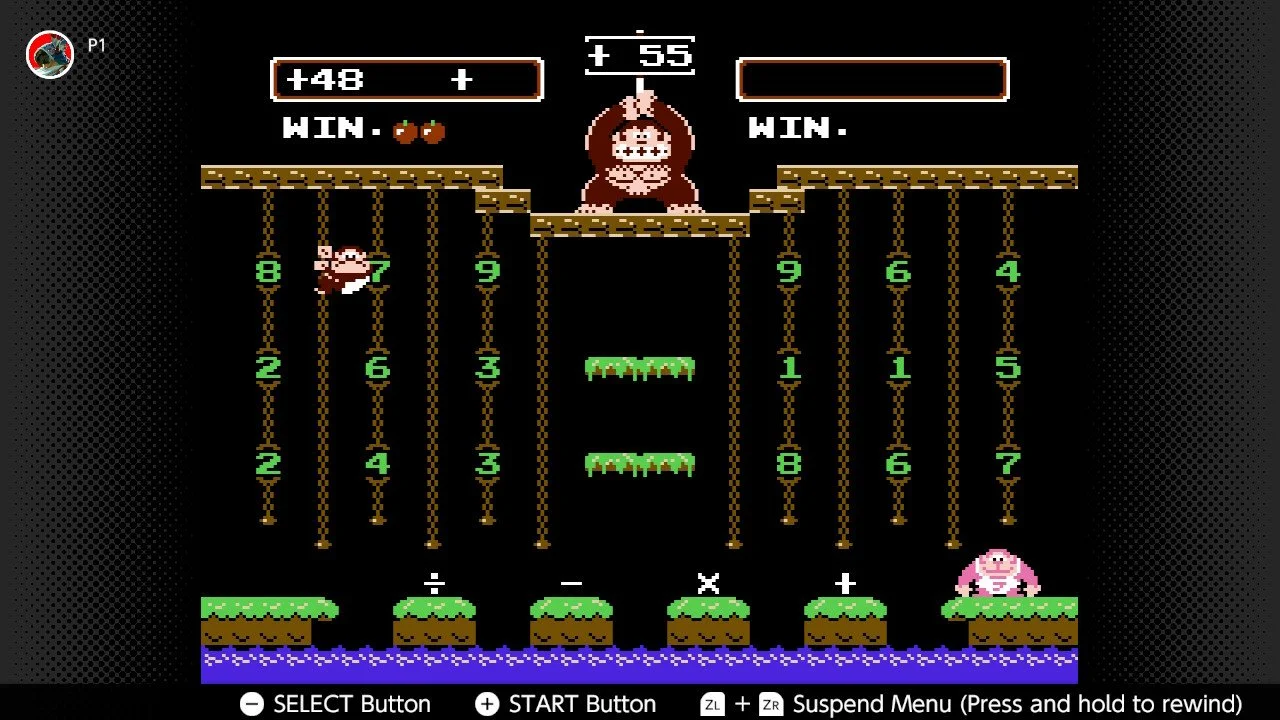
Released for the Nintendo Entertainment System(NES) on 12 December 1983, DK Junior Math is a side-view, educational, puzzle-solving, platformer game that was built off of the success of the original Donkey Kong arcade game. There’s no narrative; DK Junior is simply jumping from platform to platform trying to touch numbers and mathematical symbols in order to add, subtract, multiply, or divide numbers in order to match the number that Donkey Kong is holding on top of the screen. As the player progresses the numbers will become higher forcing players to employ multiplication in order to achieve higher integers. The game is also about platforming because if DK junior misses a jump and falls into the water he will die and the game will start over.
I played DK Junior Math originally in Animal Crossing when I “unlocked” several NES furniture items[LINK***]. I played it for a few minutes, but then quickly abandoned it for Excitebike and Legend of Zelda because by then I was a teenager who was bad at, and therefore hated Math.
I’ve written about the edutainment genre and noted that many educational games, to quote the 17th century metaphysical poet John Donne, “suck all the butt.”
DK Junior Math is not bad, but it’s not a great game (as many of the reviews for it attest). Despite this I see value in the game because I know had I been younger I would have played it and enjoyed it. The interface is simple enough it doesn’t require too much trial and error, and aesthetically speaking the game achieves what it’s trying to do which is provide a basic puzzle game to introduce simple mathematical concepts.
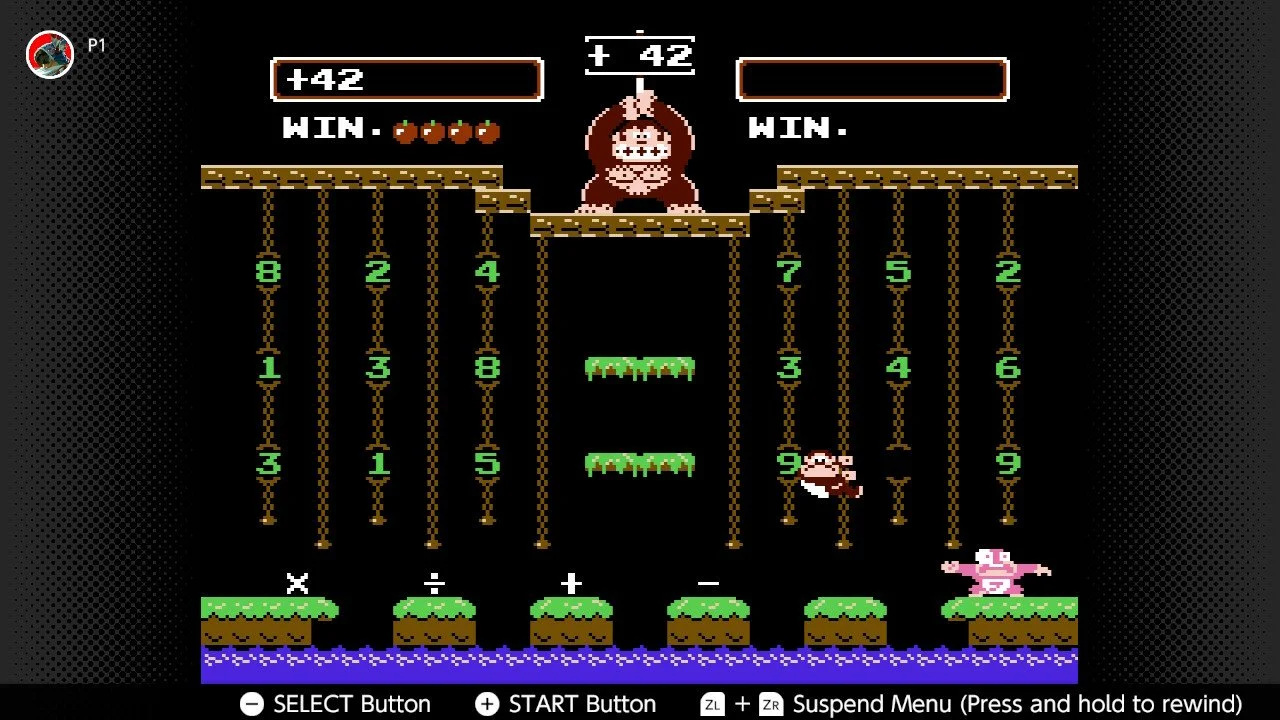
During the 1980s Nintendo was frequently criticized because their games lacked “educational merit” and DK Junior Math is clearly a product responding to that criticism. It provides an early understanding of integers, how they are formed, and how relationships between numbers develop. Most importantly it provides players a space to play with numbers which is where mathematical proficiency will develop. By fostering play DK Junior Math makes learning accessible rather than mandatory, and that difference is everything.
Education works when it fosters curiosity in an individual to pursue their own understanding.
To wit.
I didn’t want to do algebra or word problems, I was told to.
I wasn’t told to make a baby gorilla figure out how to make the number 147 using jumps from vines that were decorated with numbers, I wanted to.
Joshua “Jammer” Smith
10.20.2025
Like what you’re reading? Buy me a coffee & support my Patreon. Please and thank you.