497 Words About: Monty Python’s Complete Waste of Time
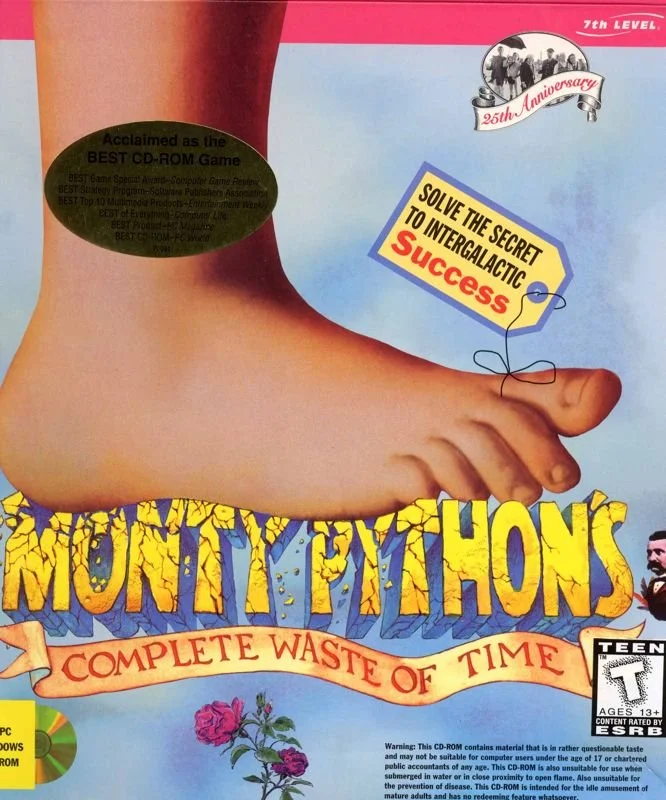
I recently discovered that there was a Monty Python videogame. Given the fact that I was one of the army of basic white dudes who watched Monty Python’s Flying Circus and Holy Grail to the point I still have random bits memorised and will summon them at will, I understood the next assignment: I had to find, and play this videogame.
I found it.
I played it.
It’s…an exercise in point and click interface design.
Monty Python’s Complete Waste of Time was originally released in 1994 for Windows 16-bit personal computers, and then again in 1995 for the Apple Macintosh. There is no story to the game, nor is there a clear direction as to what players need to do in order to progress. In fact, progression isn’t even an applicable word. Players begin in a Terry Guilliam illustrated concert hall before a pair of lips sitting on a microphone stand begins to speak a line of dialogue that is stolen directly from an episode of Monty Python’s Flying Circus. At this point the opening credits of the television show plays and then the player is transitioned over to a screen with a large Policeman’s head, a cartoon circus tent operator, a few musical instruments, and two photographs of women with their bare butts exposed and wearing knees high socks.
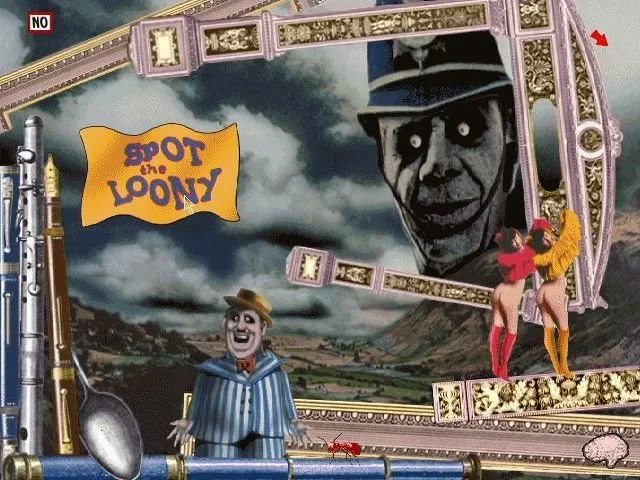
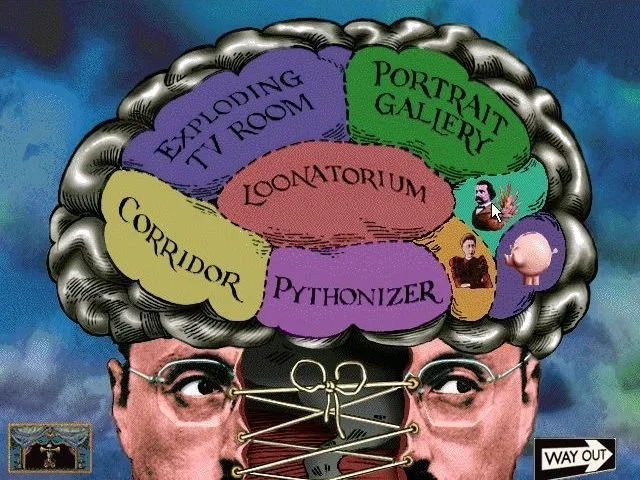
At this point the player is not given any direction where to go or what to do. Instead their option is to wait for something to happen, or to use their computer mouse somewhere on the screen. If they choose the latter an animation will take place on the screen, or a window will appear and play a section from the Monty Python television show.
This constitutes most of the actual gameplay.
I’ll be honest, I don’t actually know if Monty Python’s Complete Waste of Time could or even should be considered a videogame; it feels more like a general licensed product. But I do see value in it because, again, the player has to explore using the point and click interface in order to trigger reactions from the software. And given the fact that this game was released on some of the earliest personal computers there’s an educational system beneath this absurd software design.
The personal computer in 1994 was still a relatively new object, and concept, for many people. Games like Solitaire and Minesweeper provided early instances of edutainment to help new computer owners learn how to navigate software design. Monty Python’s Complete Waste of Time didn’t offer a fun card game, or a strategy puzzle, but it did offer players the chance to trigger John Cleese and Michael Palin in the Cheese Shop sketch or occasionally watch a naked lady riding the back of a train.
This point and click interface taught players how to use the mouse and rewarded exploration.
One could argue this wasn’t a complete waste of time, though after a few minutes, it would be time for something completely different.
Joshua “Jammer” Smith
1.26.2026
Like what you’re reading? Buy me a coffee & support my Patreon. Please and thank you.