Super Mario Sunshine: A Power Washer Platformer Simulator, 2

I promise I will explain that “2” in the title in a bit, but first I’ve been thinking about Super Mario Sunshine.
Actually I’ve been thinking about Super Mario Sunshine since the year 2002 when it was released for the Nintendo Gamecube. I believe I received it as a Christmas Present, or maybe it was a birthday present. I don’t remember buying many Gamecube games myself unless they were on the used rack at my local Hastings which is where I got my copy of Freedom Fighters and Cubivore. That latter one cost I think maybe $10 which, given its current costs on eBay is what we would refer to as an accidental long-term investment.
Before I continue, after I wrote this paragraph I texted my Mom if she remembered when and how I acquired Super Mario Sunshine and she told me I got it in an Easter Basket. Thanks Mom (for the info (and the videogame)).
Super Mario Sunshine is a 3D Platformer, fantasy, action-adventure videogame released for the Nintendo Gamecube 19 July 2002. It was the first, and only, Super Mario game released for the Gamecube (in the sense that it was a game exclusively about Mario and didn’t involve Go-Karts, fighting, or sports) and was the immediate successor to Super Mario 64. That latter game, and I can’t stress this enough, was a momentous event in videogame history because it managed to establish a model for 3D Platformer videogames, not because it was the first one, but because it established control mechanics and expectations for level progressions in that genre. Super Mario 64 also set the ground for how Mario would move physically in the next generations of platformers. I mention this just to note that Super Mario Sunshine entered the market with an enormous amount of expectation from players and videogame critics.
Spoiler alert: they didn’t hate it…but they didn’t like it either.
Naturally this is the part of the essay where I’m supposed to say players and critics were wrong and then explain through lengthy analysis why I believe that.
Instead of saying that however, I want to establish the game’s plot and then determine what it was trying to do aesthetically, narratively, and ludologically (that last word, fun fact, is not an actual word(but I’m keeping it in because it’s fun to say out loud (ludologically)).
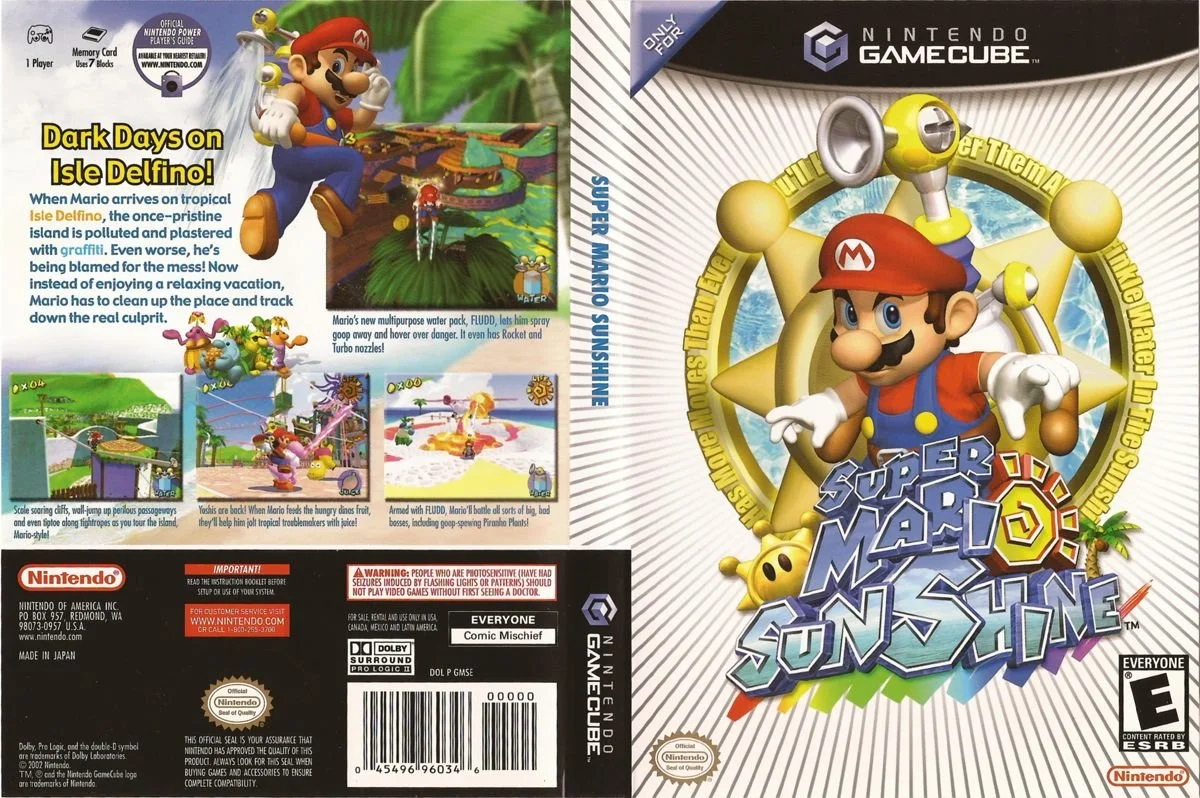
Cover Image provided by Moby Games.
In case my reader has never played Super Mario Sunshine (or wasn’t born in the late 1900s like I was) I’ll provide a quick summary. Mario, Peach, and some octogenarian Toad named Toadsworth (who’s made scattered cameos in Super Mario games since Sunshine was released) are on a plane headed for the tropical paradise of Isle Delfino. During the flight the trio watch a promotional advertisement for the island which shows the many attractions for tourists (while also providing players a chance to see the levels they’ll be playing), and during the video Princess Peach sees what appears to be a blue Mario running around in the background. When the plane lands the tarmac is polluted with some vibrant sludge that will swallow up anyone it touches. Mario is encouraged to find a solution, and while exploring the landing strip he encounters what can only be described as a water-gun-backpack-machine which introduces itself as FLUDD(Flash Liquid Ultra Dousing Device). After washing the sludge, and fighting a piranha plant made of the colorful goop, Mario is arrested by Delfino police. A cutscene of what I assume is the worst Phoenix Wright: Ace Attorney homage plays which reveals that “Mario” has polluted the island with paint and caused the shine-sprites (the in-game equivalent of Super Stars) to vanish. Mario is found guilty and told that the only way to leave the island is to clean up all the pollution and bring back all 120 shine-sprites. FLUDD agrees to help Mario, and from there the game begins.
First off the verbs of Super Mario Sunshine reveal how philosophically distinct the game was. While previous Mario games kept the verbs down to “Run,” “Jump,” and “Explore,” Sunshine included the verb “Wash.”
Hence the subtitle of this essay.
Mario’s interaction with the world and enemy non-playable characters (npcs) always involved direct physical interaction. Mario would jump on top of a Koopa-Troopa or a Goomba and squish it, in fact jumping on enemies was the sole way of defeating them (unless you count Super Mario RPG and Paper Mario) I’m planning on writing about those games in the future so stay tuned for that)). Super Mario Sunshine did not abandon that mechanic, and in fact there’s several enemy npcs that can be easily dispatched this way.
However, there’s the issue of all that bloody paint.
Most of the initial enemies Mario will encounter on Isle Defino cannot be jumped on because they are either coated in paint or else entirely composed of it. To wit, the first spot in Isle Delfino that needs to be cleaned is the town square where another Piranha plant has set up shop and along with that there are various Goobles literally bubbles of paint that will spread the goop as they move and attack Mario if he walks within triggering distance.
Also that’s literally the character’s assigned name: goobles. I Googled it thus prompting this sentence into being.
I googled for goobles.
Life is…life is truly beautiful sometimes.
Back to the game.
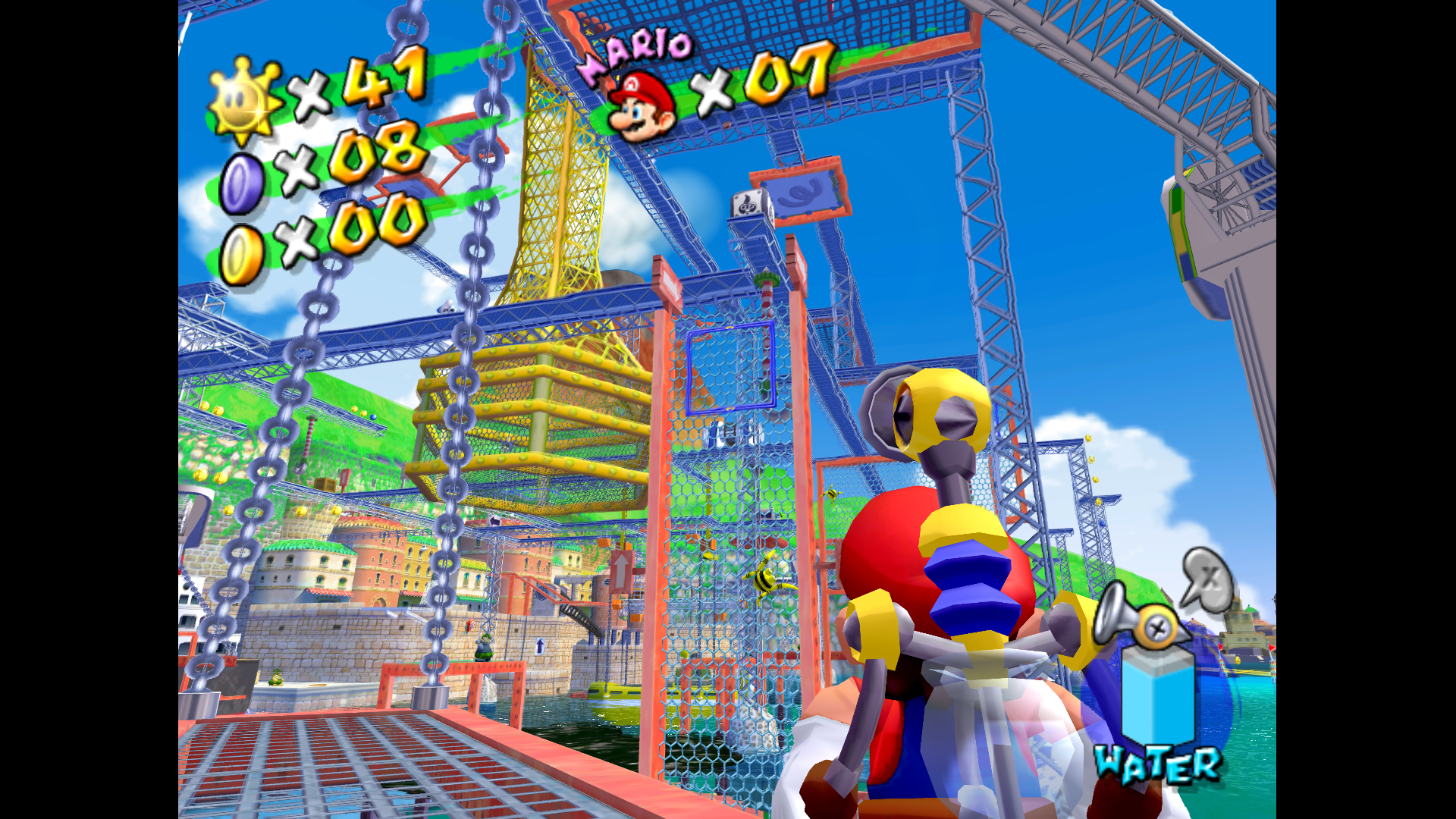
There’s no point trying to use the verb “jump” against a gooble because Mario will immediately become covered in paint, and if too much accumulates on him his health points (hp) will begin to drain. Likewise if Mario steps onto the paint I lose control of his avatar and he begins to run in place before tripping and unintentionally spreading more of the paint. This last part is important because, again, Super Mario Sunshine is a 3D platformer and in any platformer videogame footing is everything.
Platformers are by design about challenging players' ability to master the control mechanics of the game and then provide a series of challenges to test the player’s ability to use those mechanics under pressure.
One example of this is the third level of Ricco Harbor titled “The Caged Shine Sprite” where Mario has to navigate a maze of scaffolding beside a local pier in order to reach a large metal cage which is holding a shine-sprite. I quickly abandon trying to answer the question “Why don’t the citizens of DelFino just grab these shine-sprites if they’re out in the open” and begin the actual scaling of this edifice. It’s not enough to simply climb up to these platforms however because there is no direct starting point. Mario will have to begin by climbing a grated fence which is populated by a few yellow spider-creatures that will try to knock him off, and from there he will then have to jump onto hooks which are moving back and forth in a closed circuit. From there he will jump between steel platforms and what amounts to industrial trampolines in order to reach the thin rails of steel where blooper squids await to spit wads of ink in his direction or where spirits literally made of wind begin to emerge, circle around the fat plumber, and then collide into him trying to get him to fall into the ocean below. And if all of all of this ain’t enough, controlling Mario is not always an easy task because he can shift into running in one press of the joystick and the platforms I’m navigating are thin which means I fell off of those wretched, bloody platforms enough to learn most of the curse words I currently employ on a daily basis.
Every level of this one mission uses npcs in its design to challenge Mario’s footing because, again, the purpose of the challenge is navigating 3D space while also controlling a figure whose gravity is not static.
And again, there’s the bloody paint.
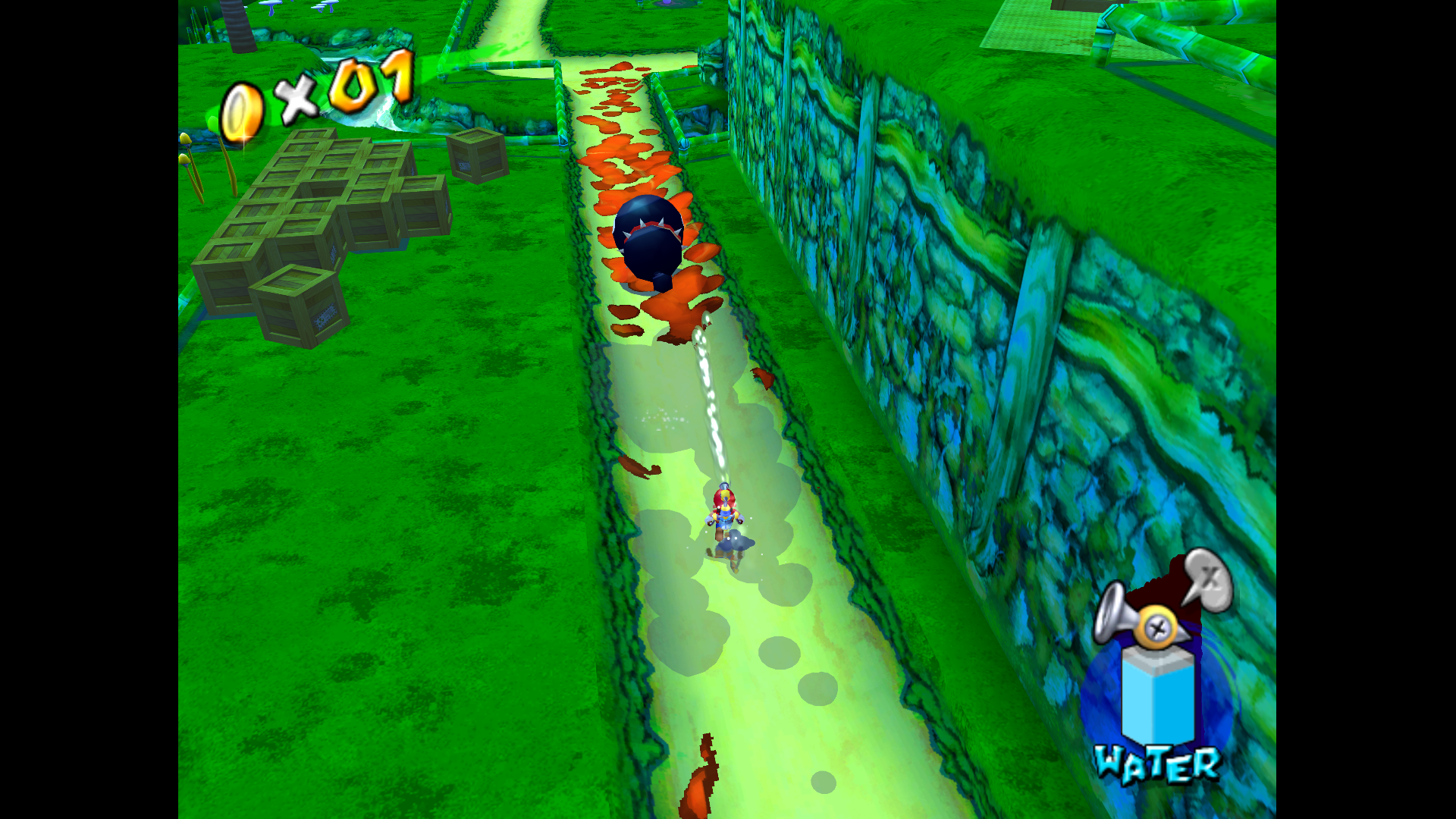
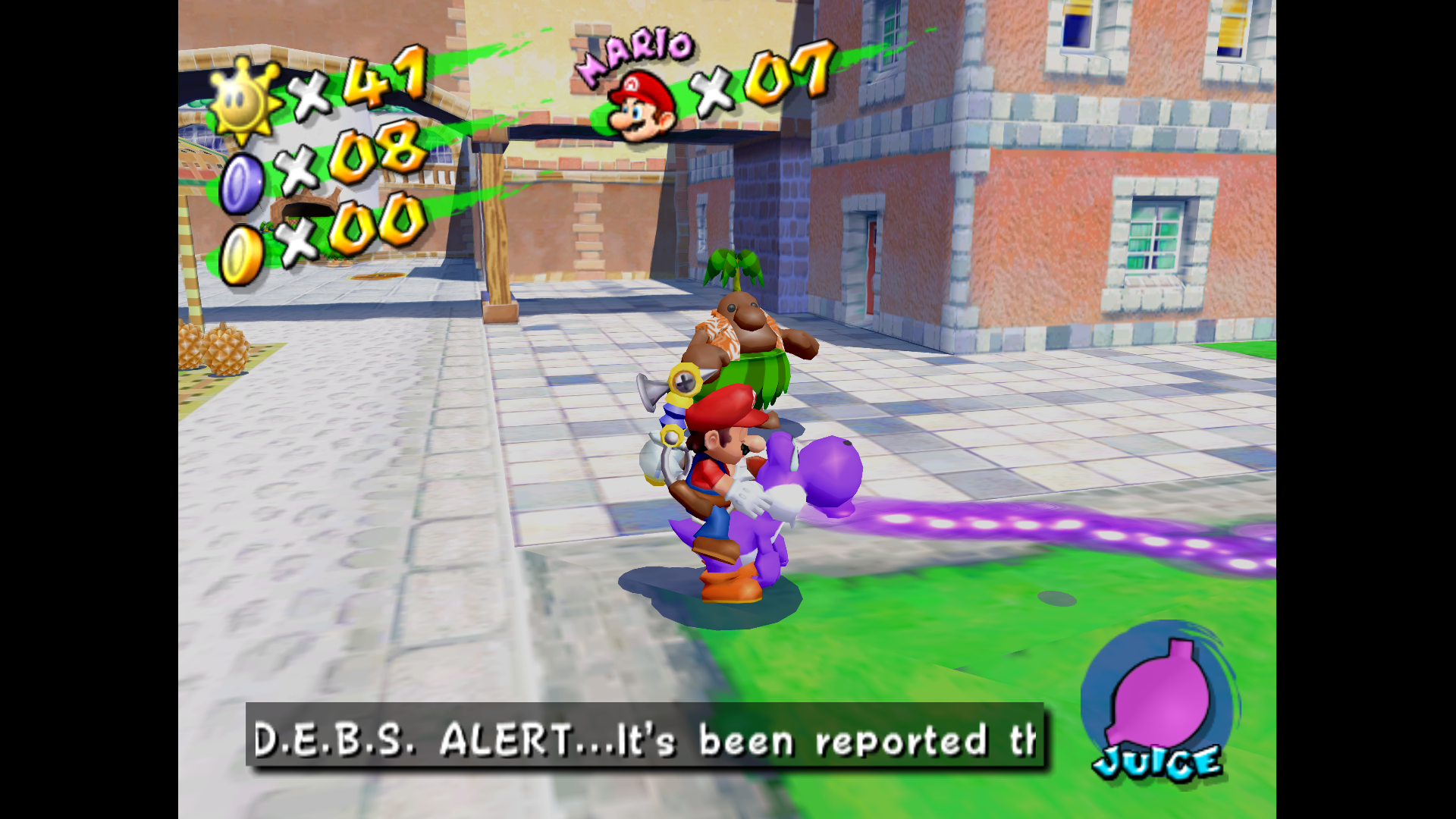
Super Mario Sunshine leans as much on the verb “wash” as it does “run” and “jump,” because every level has, on some level, paint/goop that needs to be cleaned from the surface of the Isle DelFino. Along with all of this paint there are various trinkets such as blue coins that can typically be acquired by washing large red letter “M’s” off of walls and floors. There are shapes that can be cleaned off of walls prompting a quick running mini-game that will yield rewards. When Yoshi’s finally appear in the game they can “wash” away goop with colorful projectile vomiting. That last one was probably something that sounded cute in the writer’s room, and as much as I love this game, and Yoshi, the colorful vomit is still a tough sell. There are boss battles that require Mario to shoot streams of water to reveal vulnerabilities or else simply cause damage. And, of course, almost every level in the game requires Mario to wash the corrosive paint just in order to move about the world freely.
I make the joke, but I also mean it unironically that Super Mario Sunshine is as much a power washing simulator as it is a 3D platforming videogame. In fact it’s because of all this washing that Mario is able to move forward at all.
In this essay I wanted to observe how this washing simulation impacts the platforming since Super Mario Sunshine is a 3D Platformer. Every level of the game incorporates moving Mario in and around 3D spaces and will incorporate jumping challenges or timed races. Mastering the mechanics of Mario’s physical motion is the key to success, and as always the player will have to maneuver around what videogame critic Tim Rogers refers to as Mario’s sticky friction. One of the reasons I never finished any Super Mario Game until 2024 was because Mario’s movements have a gravity that even after decades of playing I’ve never completely mastered. Just like in its precursor Super Mario 64, controlling Mario’s body in Super Mario Sunshine is about juggling gravity which means player’s aren’t just avoiding enemies; players are also narrowly avoiding losing control of Mario.
The paint, in the words of Charles Dickens, re-ups the challenge.
Every drop of paint on Delfino Island is an obstacle for control, both in the immediate literal sense, but also for narrative purposes.
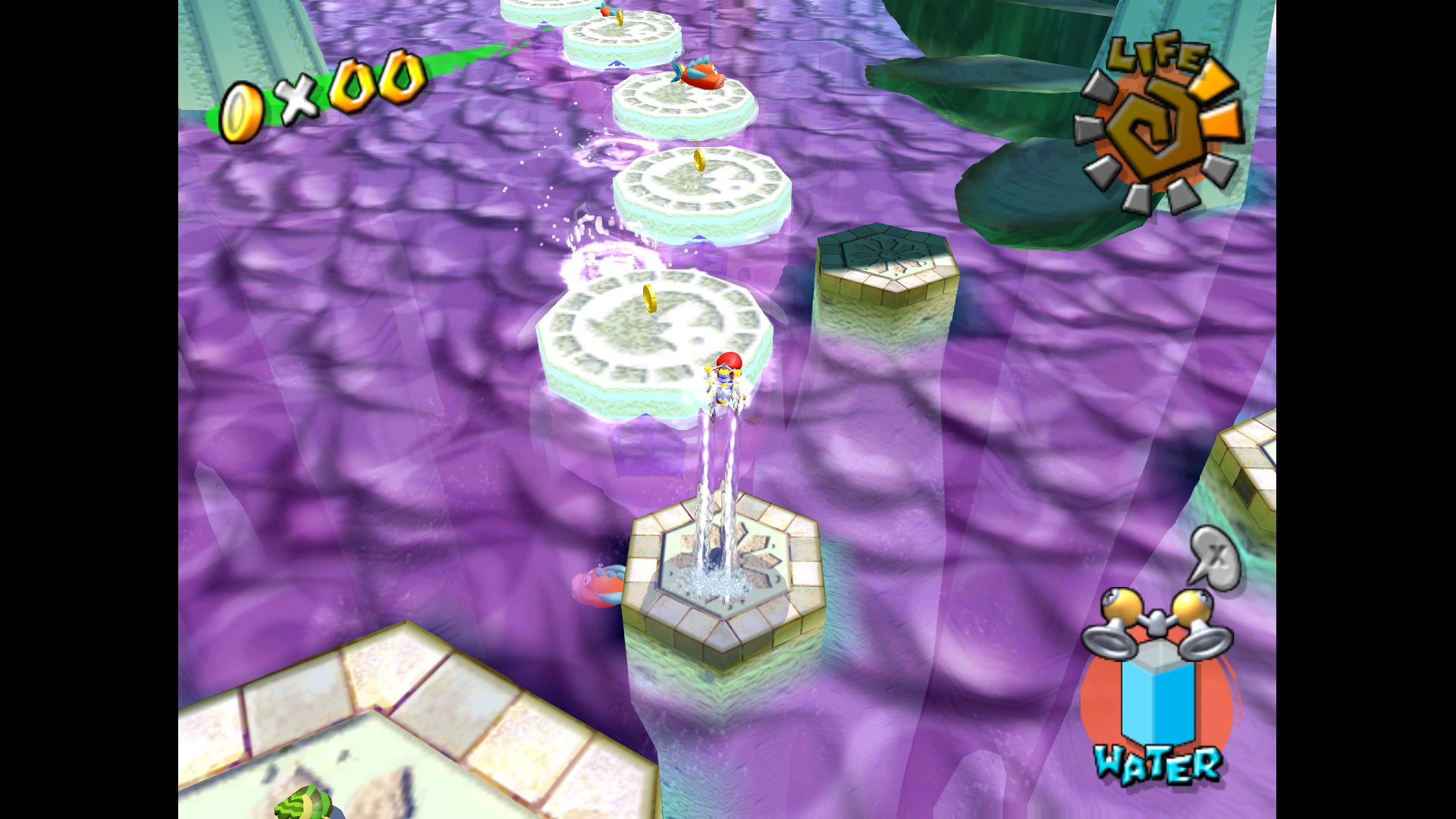
As the game progresses, and Mario completes missions and acquires shine-sprites (and discovers some of them which are hidden around the island) the sunlight steadily begins to reappear and eventually the true antagonist appears. Spoiler alert it’s Bowser…or, actually, it’s Bowser’s son Bowser Jr. a.k.a Baby Bowser, a.k.a. Lil ‘Baby, a.k.a. Lil’ Bowser Doritos Locos Supreme.
Fun fact, those last two names aren’t real.
Bowser will appear later in the final Boss fight which is apparently in a giant hot-tub, but that’s for another essay.
Bowser Jr. believes that Peach is his mother and has purposefully pretended to be Mario to get him arrested. Using a magic paintbrush made by Professor E. Gadd (the same old dude from Luigi’s Mansion who made the vacuum pac (and also The FLUDD) Baby Bowser has unleashed a malevolent ruin upon the island and, to quote the 19th century poet Walt Whitman, “Totally messed stuff up…yo.”
This narrative is admittedly goofy, but Super Mario Bros. has always been ridiculous in terms of its narrative goals. Ever since the first Toad told Mario that their princess was in another castle, the Super Mario Bros. games continually relied on absurd narrative structure. Nintendo prioritizes fun and enjoyable gameplay mechanics over more cerebral storylines, and I’m going to be completely honest, I enjoy it. When I play Super Mario games I know what I’m getting and what to expect. It's a hyperbolic fantasy, with Mario being the hero who must rescue the damsel as well as an entire island of people who literally possess trees on their heads.Super Mario Sunshine is surreal, wacky, colorful, and genuinely ridiculous which is why I’ve been thinking about this videogame since 2002.
On that note I’ll finally explain the “2” in the title.
I actually wrote this essay once already but by the end of the draft I didn’t like what I had written. In fact, I hated it. My contempt for the original draft was mostly due to structural issues in the writing itself. Several paragraphs felt stilted and didn’t connect the way I wanted them to. But it wasn’t just those problems. The writing itself, tonally speaking, sounded like a podcast about wiring diagrams delivered via a Ham Radio. Put another way, it was just incredibly boring and didn’t dig into the meat of why I think Super Mario Sunshine is so interesting in terms of videogame history and design. So, I picked the skeleton of that wretched essay for the parts I liked, pasted them there into a new word document, and tried again. Hence the “2.”
I know myself enough to know I was being overly critical of my writing, but dang it I’ve been thinking about Super Mario Sunshine for over 20 years. I’ve had two decades to find the words to say something meaningful about this videogame that’s beyond a pithy “8 out of ten.”
I wanted to say more because I kept fixating on the fact that unlike any other 3D platformer I’ve played, Super Mario Sunshine didn’t just depend on the verb “jump.” Adding the verb “wash” has real implications for understanding and analyzing the design that went into this game because it created a dynamic of play I haven’t encountered in another videogame.
Washing all of this paint makes it easier to control Mario during missions, but it also steadily shows how Mario is making a difference in the world around him. In a previous essay I wrote about how acquiring sunglasses is proof of this. As Mario cleans up more paint, the main plaza, as well as the other levels, become visibly brighter and the citizens of Delfino will become happier in their interactions. If I may use the old platitude: nature is healing. But more importantly the player is steadily acquiring confidence in their ability to enact change. Washing and cleaning the world has narrative depth because even if this is a cartoony videogame it digs at the heart of what makes cleaning in real life so pleasurable, and why the game Power Washing Simulator is as well reviewed as it is.
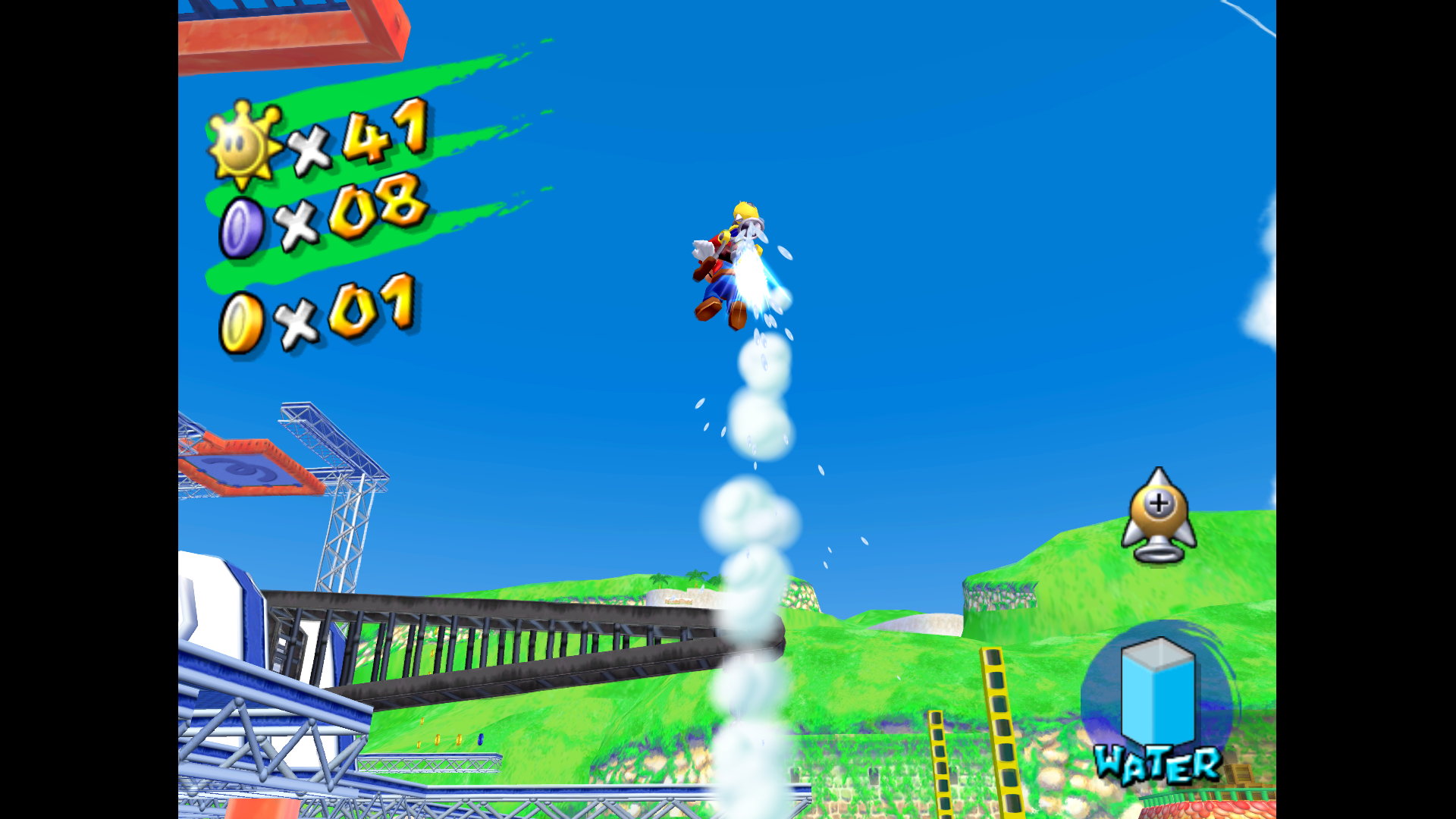
Human beings derive pleasure from creating personal environments, and while there are some individuals who can live in “disorder” I feel confident in writing that most people derive some pleasure from cleaning and organizing. Even if the process isn’t fun, the act of organizing and removing filth releases endorphins and instills confidence. Put simply: cleaning can make people happy. Nintendo as a company is driven by the philosophy of inspiring joy in their interactive media and so as I consider Super Mario Sunshine from a ludology perspective it makes complete sense to me why Super Mario Sunshine scratches the intellectual and emotional itch it does.
Washing the streets of Isle Delfino clean is fun.
Washing the graffiti off of walls is fun.
Blasting Petey Piranha with water and then butt-stomping his guts is fun.
Seeing the paint and goop wash away triggers a symphony of chemical reactions in my brain comparable to popping bubble wrap or removing the plastic film from a new smartphone screen. It’s a physiological response to cleaning the world and bringing order and organization back into existence.
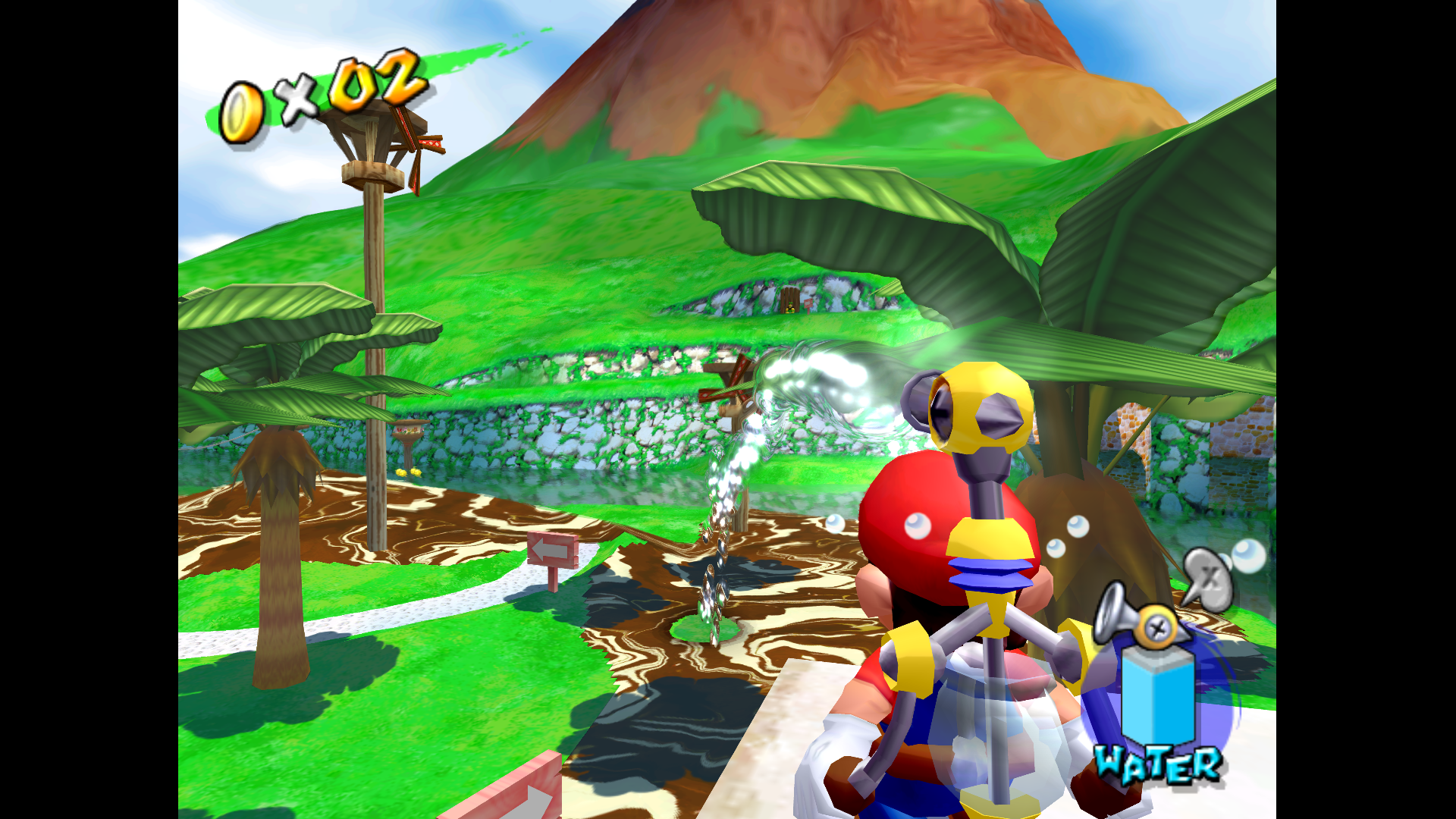
The platforming of Super Mario Sunshine is unique in the series because it was built around the traditional structure of maneuvering an avatar though space, but it also incorporates a pseudo-third-person shooter mechanic that hasn’t been repeated since. Or, at least, not in the Super Mario games. This is honestly unfortunate because, while the control mechanics in the game weren’t perfect, with a little restructuring this design could and would be improved. I’m not saying I want Super Mario Sunshine 2…huh.
Actually, I am saying that.
I will say that.
I want Super Mario Sunshine 2.
I’ll say it again.
I want Super Mario Sunshine 2. I want it for entirely selfish nostalgia-driven reasons, but I also want a Super Mario Sunshine 2 because there would be a chance to make a platformer game that’s as much about cleaning the ground players stand upon as it is making and succeeding accurate jumps. I believe this is the reason I’ve been thinking about Super Mario Sunshine, lately, and regularly since 2002. There’s a chance to make a game that’s unique and combines two game mechanics that on consideration shouldn’t work, and yet they do.
Decades later I’m still thinking about Super Mario Sunshine’s power washing simulation, though I’m also still wondering why Yoshi had to vomit digested fruit.
Joshua “Jammer” Smith
12.19.2026
Like what you’re reading? Buy me a coffee & support my Patreon. Please and thank you.